
IN CONVERSATION | MV+A and LandDesign
MV+A Principal Brian Szymanski recently sat with LandDesign Principal Joe Giangrandi, along with moderator and LandDesign Principal Ashley Clark, to discuss the nuances of putting together project teams, successful collaboration, retrofitting suburbia, and lessons learned from their kids.
Excerpts from their conversation have been masterfully deployed in a forthcoming marketing video focusing on the collaborative process produced by Ashley and her LandDesign associate Grayson Sands. We are grateful for their incredible effort and for including MV+A in this unique opportunity to reflect upon and celebrate our respective collaborative cultures.
The text below is an excerpted, and in some instances, paraphrased account of their conversation. To watch the full discussion please check out our YouTube Playlist: In Conversation.
Ashley Clark [AC]: Brian, when you are putting together your project teams, what is really important to you in selecting consultants to help you achieve your goals?
Brian Szymanski [BS]: First, I think the group must share our value for design excellence and then, share our value of Client service…AND can work at the pace at which we like to work—which is lightning fast. And, with respect to the Client, is always willing to say YES and have that ‘can do’ attitude that we know our clients are looking for.
Joe Giangrandi [JG]: So, the big thing working with MV+A on these projects is to really cultivate experience—not only the design experience, but the Client experience along the way. Sometimes you get these smiles from the clients during meetings upon seeing how we work together in the 3D world. They really enjoy the experience—the journey getting to the design is almost as fun as the built product in the end.
BS: When I speak to design excellence, it’s not just creating plans that, you know, look nice in plan; it’s really understanding what it’s going to feel like to be in that space and helping the Client find that vision. That comes not just from the architecture and the landscape design, it comes from knowing the location of the site. It’s doing studies and helping the Client determine the character of the space that they want—which will later inform choices in color, in style, in material, and things like that.
JG: I think there’s this, kind of, great unveiling of the vision, right? The Client has this idea of what they want—sometimes it’s just in words, maybe there’s some photographs they’re thinking of when we start to bring that together with the architecture and the landscape and they get to experience it. When the vision is seen and the character is right there in front of them, and then it’s like: “YES, this is what we want”—that’s super gratifying.
BS: I think there’s a balance too. I speak to being efficient and ideating quickly, but there are also moments in the project where you want to slow down, take a step back, and understand why you’re making certain decisions and try to set a framework for future decisions—so you’re making decisions to meet a particular character or a strategy that you’ve determined as a team. And then all of your decisions feel correct because they’re based on a shared vision.
 MV+A | LandDesign Project Collaborations [Clockwise from Left]: The Edmund at Halley Rise, Reston, VA; Cascades Marketplace, Sterling, VA; Lulah Hills, Decatur, GA.
AC: Could you talk a little bit about that very early stage of collaboration, working on the design, and how you’re helping the client see what’s next and getting through that initial stage?
BS: So, Cascades Marketplace is a project where we started with a bunch of scattered ideas, and that’s a moment, as I spoke to, where were we recognized we needed to slow down and build a framework to inform the future ideas. We specifically went through a visioning process where we developed three different approaches to the design of the project. Then we did studies showing if we use this approach; here’s what retail might look like, here’s what big-box retail might look like, and here’s what townhomes might look like.
Ultimately, the Client helped us decide on which one of these felt right for the demographic that they thought was going to go into this project. And that informed ALL later decisions: paint colors, light fixtures, furniture, plantings, and things like that. All of our decisions had a framework that we could lean back on, one that had already been vetted by the Client. So then, when it all comes together, it has a cohesive feel to it. I think all of this ultimately creates a much richer project. It was really a richer experience for everyone; I think it was a new experience for our client, Willard Retail.
JG: We came in with a vision that, holistically, the design looks cohesive around the experience of a place. There’s a thread or a vibe that the whole neighborhood has but the little experiences along the way, within a place, are of that that same thread but have some uniqueness to them; they’re customized. There’s not a blanket sameness across the site. There’s multiple experiences, multiple ways of experiencing things and details that make it stand out and gives it that character.
Lula Hills was another project where it’s very honed in—everything feels the same, but no detail is exactly the same.
BS: Yeah, for that project we kept speaking of this term: the Decatur Funk. This is in the area of Decatur, just outside of Atlanta, Georgia. We spent some time identifying what the Decatur Funk means and how we could take a feeling from a place that already exists and bring that into a brand-new place? And what are the elements of that place?
This project is over 70-acres with a series of open spaces, and we wanted to zoom into individual moments of that—I think we spent as much time on that project looking at the backs of buildings, in the kind of behind-the-scenes spaces, as we did in the front, to make sure that there’s a high-level of experience moving completely through the site. And what are the little elements that are going to make this project unique and special so that your kid is going to come to and want to play with and play on and remember.
JG: Yeah—that’s a that’s a good point. One of the key things when we’re designing these spaces—Brian’s got small kids like I do—is if I take my kids here, are they going to want to stay? Are they going to want to play on these things? So, it’s always fun to take our kids to our projects and they’re just, you know, they’re crying when we have to leave. That’s always a fun aspect of the job too!
BS: With all these projects, our ultimate shared goal is to actually get them built. It does nobody any good to have a beautiful master plan that, once you go to price it, or go to construct it, it doesn’t work and can’t happen.
So, we have to share the Client’s goals of cost effectiveness early-on, in all of the decisions we make, if our goal is having a built project at the end. I think a lot of urban master planning projects tend to have a break from reality because the vision is so large. Or they’re in locations the design teams might not be connected to, or the timeline of the project is so long that those decisions might not seem as important. But we’re thinking as if we’re immediately going to build it; we need to think in reality and make decisions that are going to help this get built or it’s not helping anyone.
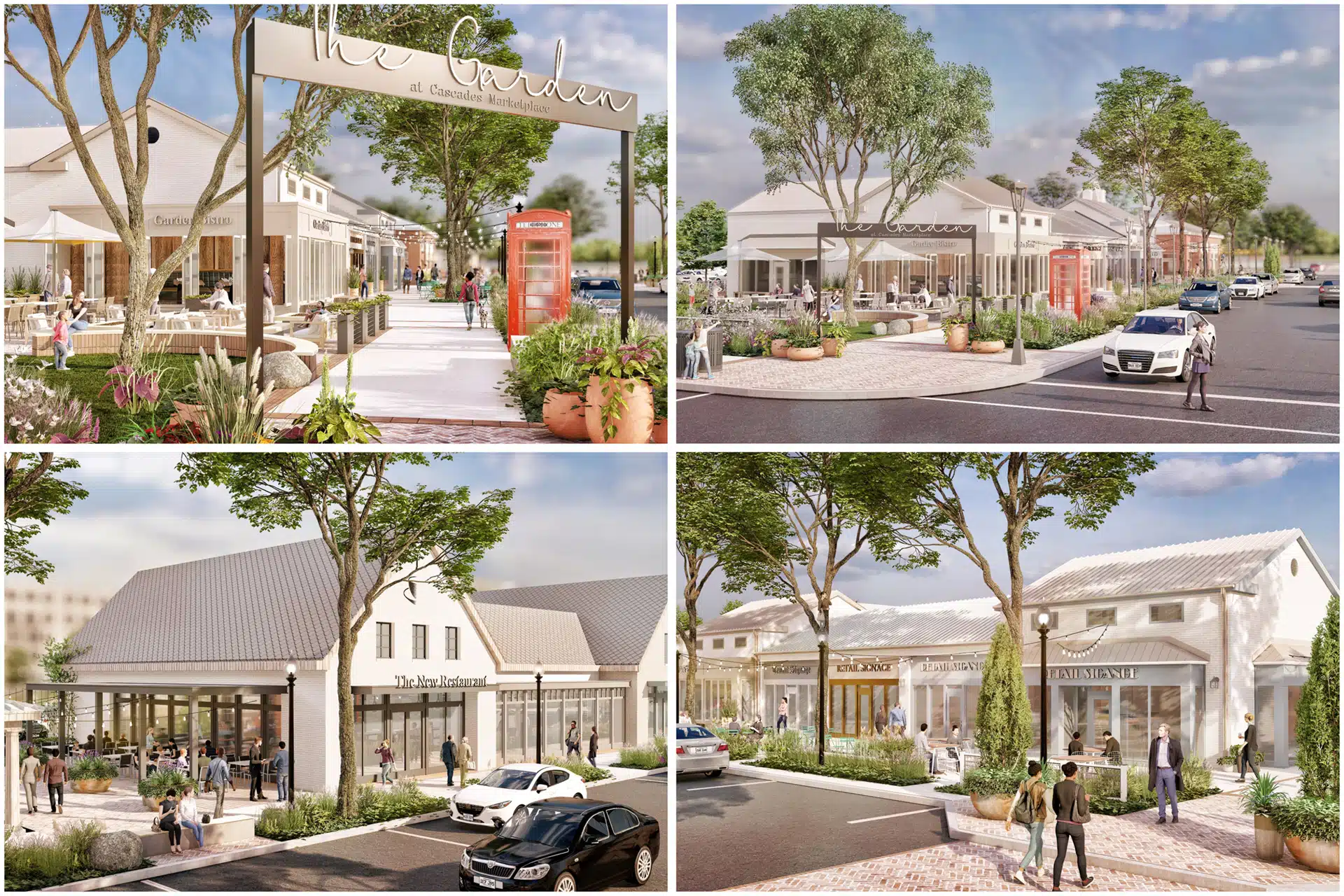 Renderings of the Proposed Cascades Market Place Project
 Renderings of the Proposed Lulah Hills Project
AC: Brian, tell me about your working relationship with LandDesign. How did that begin?
BS: The first project we worked on together was Halley Rise, which is a 36-acre, mixed use development in Reston, Virginia for Brookfield Properties. At first, Brookfield really just asked us to come in and help them get a Wegmans lease for one of the buildings in the project and, in a matter of a month, we had a letter of intent. The whole process just went so well with Brookfield that they then asked us to look at the whole project and help them entitle the entire project.
JG: So, Land Design had been working on the project previously before MV+A came on to look at the Wegmans. There was great value in understanding the grocery tenant and how they would operate and how that could work with the landscape architecture piece. Like, locating the entrance where it was really helped us to understand how to program the park that was adjacent to it; we needed spill-over space, so if you’re getting food at the Wegmans, you take it outside for lunch—you’re right there at the park.
BS: This really was the first time I think Joe and I had worked together, and we very quickly realized that we had shared values and were just very similar in the way that we worked. We both shared values for design excellence and really getting into the details. And then we had a clear shared value of client service. Like Joe, I never want to tell the Client no—that something can’t be done or that I can give it to you in three weeks or something like that. I always want to say yes, yes, yes. And I could immediately see that he was doing the same.
I was stunned at times when the Client would ask: Can we get a rendering here, here, here, here, here, here, and here? And I would wait for him to say: “Are you kidding me? No way!” And then he’d say: “sure, we can do it.” And then I would quickly ask: “How can we help you meet this goal?”
JG: We also quickly realized that we had our shared values with how to produce our deliverables, right? I think the way we were able to quickly produce these types of experiential views or walking tours, if you will, of the project in the early stages. It just really helps communicate what we know; it gives them confidence that we can back up what we’re talking about.
And the topography of that site really was challenging—I think there was at least 12-feet of grade change just along the main street—and we had to solve the challenge of getting people from the ground floor to the second floor of the grocery. So, I can ask Brian: “Hey, can you add some steps in the building so we can accommodate this thing outside? It’s going to be monstrosity if we have to take up all the grade out here, or something like that. I think we do a great job of working to make one another’s challenges less challenging. Brian’s looking outside to help solve problems inside and I’m looking inside to help solve problems outside— that’s just the nature of our collaboration. We are partners in the success of the project, right? So, we want to find the ways to make it the best project possible.
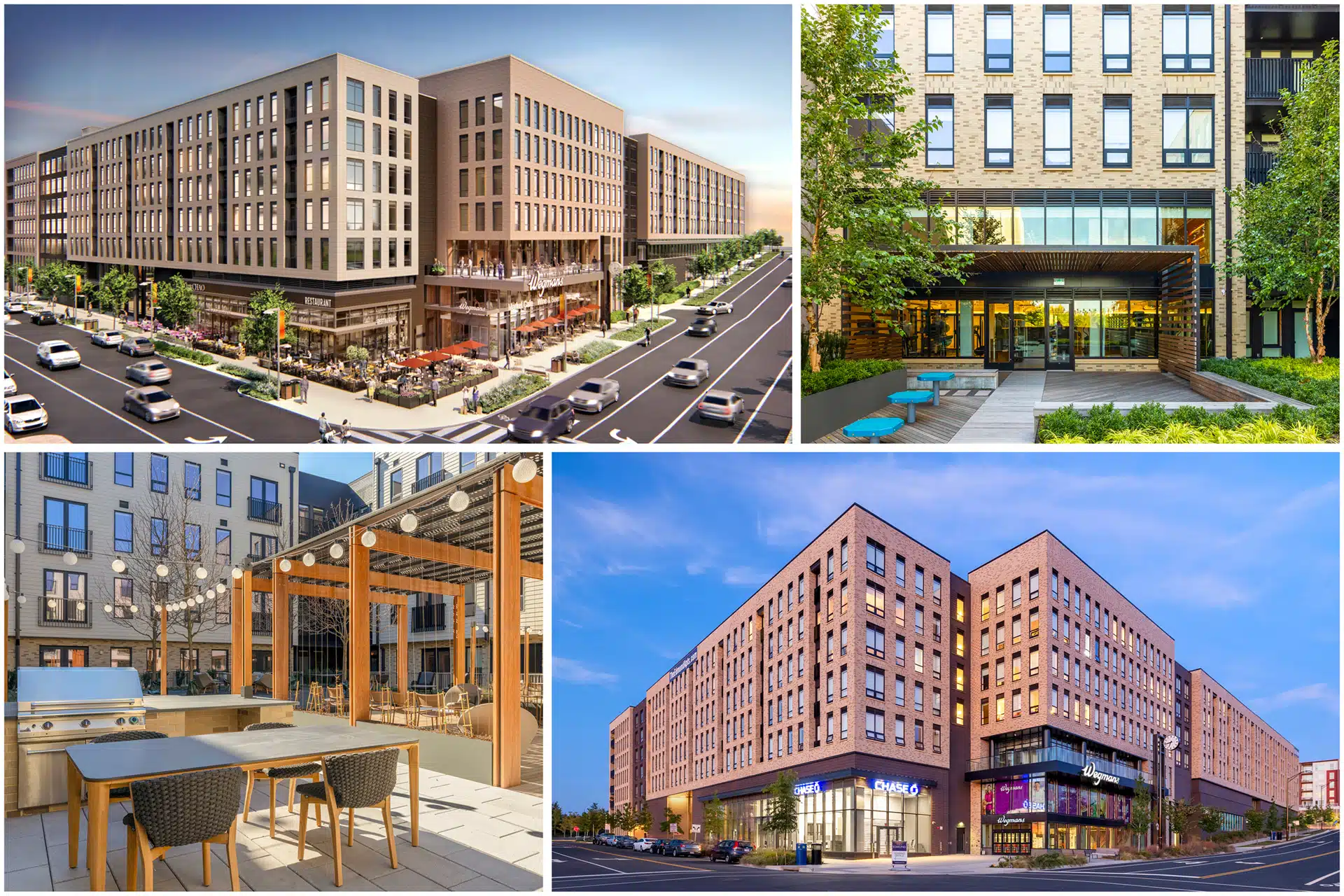 The Edmund at Halley Rise: Rendering [Top Left] and Photos of Completed Project
AC: Many of the projects that we’re talking about here fall into the realm of retrofitting suburbia, right? You’re transforming traditional, suburban commercial properties into more mixed-use urban destinations. Let’s talk a little bit about that kind of work.
JG: First off, the retrofitting of suburbia is why I got into landscape architecture, or at least like why I love landscape architecture. Have you ever driven or walked down a street and thought: Somebody should really do something with that property? We get to do that! There are abandoned parking lots or office buildings that just aren’t being used and we’re fortunate enough that our clients hire us to imagine what they could be. We’re really focusing on making sure that previously developed land is being redeveloped in a way that people will use again.
BS: Yeah, that’s a common thread through the projects we’ve worked on together—all these sites are existing or former shopping centers that are underutilized—like our Cascades Marketplace project. Or they’re underutilized or vacant malls like North Dekalb Mall—our Lula Hills project—or they’re underutilized office parks like our Haley Rise project. These are the sites that just have more to offer in terms of increasing density, or the mixing of uses, or walkability, or creating new open spaces. And in an are alike the DC / DMV region, where land simply isn’t as available, these are the sites that have the most to offer. And, as this area continues to evolve, those are the sites that are going to continue to grow.
And these sites have their own challenges. They can’t always handle a massive project all at once—just bulldozing everything and going from there. I think the phasing of these projects is very important to think through, especially as people who use this site transition from the way that they’re used to shopping—driving to the site, getting in and out, getting used to structured parking as opposed to surface parking. If there can be a period of adjustment, I think these projects will be more successful. So, our experience in thinking through the phasing and the long-term process that it takes to get these projects done is so important when looking at these existing, functioning sites and how you can slowly make transitions to a new development pattern.
JG: The types of infill happening now really require more complicated landscape architecture solutions; the requirements for open space now is more than just a grass field with a couple of benches. It’s highly programmed spaces with water features and retail lining. And really, that synergy between having retail has been huge from the standpoint of laying out a project and also making sure that we’re thinking about how the landscape going to service the retail that’s there? While I’m waiting for a table, are there places for my kids to play? It’s all those things that come together to make these new projects really have character and a place that you want to hang out. It’s not just: I drive there, I go to a restaurant, and I drive home. We want people to linger.
I think a goal for a landscape architect working the exterior experience for all of these projects is when people come to our projects, we want them NOT to be on their phone. It’s always great to have the Instagram moment, but when you find yourself engaged in a place and you’re not on your phone—you’re there, you’re in the space!
BS: Another thing we’re seeing with this concept of retrofitting suburbia is a change in the way people use space. For many years, just because there were more greenfield sites available, we saw more auto centric development patterns in retail—namely strip shopping centers with surface parked retail. And, as that land becomes less available, we’re being forced to use denser development patterns and people are having to react accordingly and adjust their own patterns.
But there are things that don’t change, grocery stores still need a certain amount of parking, all these projects still need to be serviced by automobiles; I don’t think we can just assume cars are gone, we still need to think about vehicles and how these places are going to transition. And I think that goes to the phasing of some of our projects where it’s not just a quick transition from what it was to what it is now. It’s a slow rollout, and we’re hopeful that as more people get used to well-designed places like this, they’ll be more comfortable going to them, using them, and building more of them.
 Renderings of the Proposed Virginia Village Project
AC: You are both dads, and both users of these spaces with your kids in tow. So, what have your kids taught you about making great places?
JG: I hope there’s ice cream close, for them, and coffee close by for me—or beer for later.
BS: …and as much stuff as they can possibly climb on. But, I think it’s also important to just think of the safety of spaces, where the spaces are located and how they’re interacting with vehicles. And are you creating places that are safe for them to run around and play—especially if you drop your attention for a moment. Are you going to feel comfortable with them interacting in the space?
JG: I think being a dad has made me a better designer because now I’m realizing that three-year-old’s NEED barriers or they will just run into the road. When we were working on Lula Hills, we had different areas for different age groups and the open spaces, and the retail associated with those. So, understanding how to program each space for different demographics was very enlightening and a challenge at the same time, but it was fun.
BS: And this was also a collaboration with the Client and their leasing teams. If this is going to be a space that’s more oriented to young children, what is the tenant mix that supports that? Whereas over here, this is a little more adult oriented so what is the tenant mix that supports that? And again, it all comes into the visioning process and bringing all the stakeholders into the project in. It’s not just the developers but their leasing teams along with us from the beginning.
JG: It’s really just understanding our client’s vision for the project and their game plan for how they want their retail to work. It’s like, we want to make sure that what we’re proposing really is based on what they’re trying to achieve.
BS: Getting back to our kids, Joe and I are in the same phase of our life: We both have young kids. We both have spouses who are in the same industry as us. And I think we’ve had countless calls together where we’re hearing kids screaming in the background and having to navigate, you know, our professional and personal lives. It helps cement our working relationship together because I know he’s dealing with the same stressors as I am. So, I think it’s helped us work together and collaborate better through each of these shared projects.
