

HOUSING FUTURES | A Regional Imperative
In this next installment of our Housing Futures series, we take a step back from individual housing typologies and design solutions to consider the broader system in which they operate.
While innovation in design, construction, zoning, and policy reform remains essential, there is growing recognition that fragmented approaches—limited by jurisdictional boundaries or institutional silos—will never fully address the scale and complexity of the housing challenges we face.
If there is one certainty in the housing debate, it’s that no single jurisdiction, agency, or profession can solve the housing crisis alone. Across the DMV the scale and complexity of housing challenges demand a different model of engagement: one that is regional in scope, cross-disciplinary in participation, and systemic in approach.
We are living through a moment of overlapping crises: a shortage of homes at all price points, mounting barriers to development, and persistent inequities that deny access to stable housing for too many residents. Each of these challenges is urgent in its own right, but together, they reveal the limitations of siloed thinking and fragmented policy responses. If we are serious about reshaping our housing future, we must embrace collaboration—not just in theory, but as a practical framework for aligning efforts across geography, governance, and expertise.
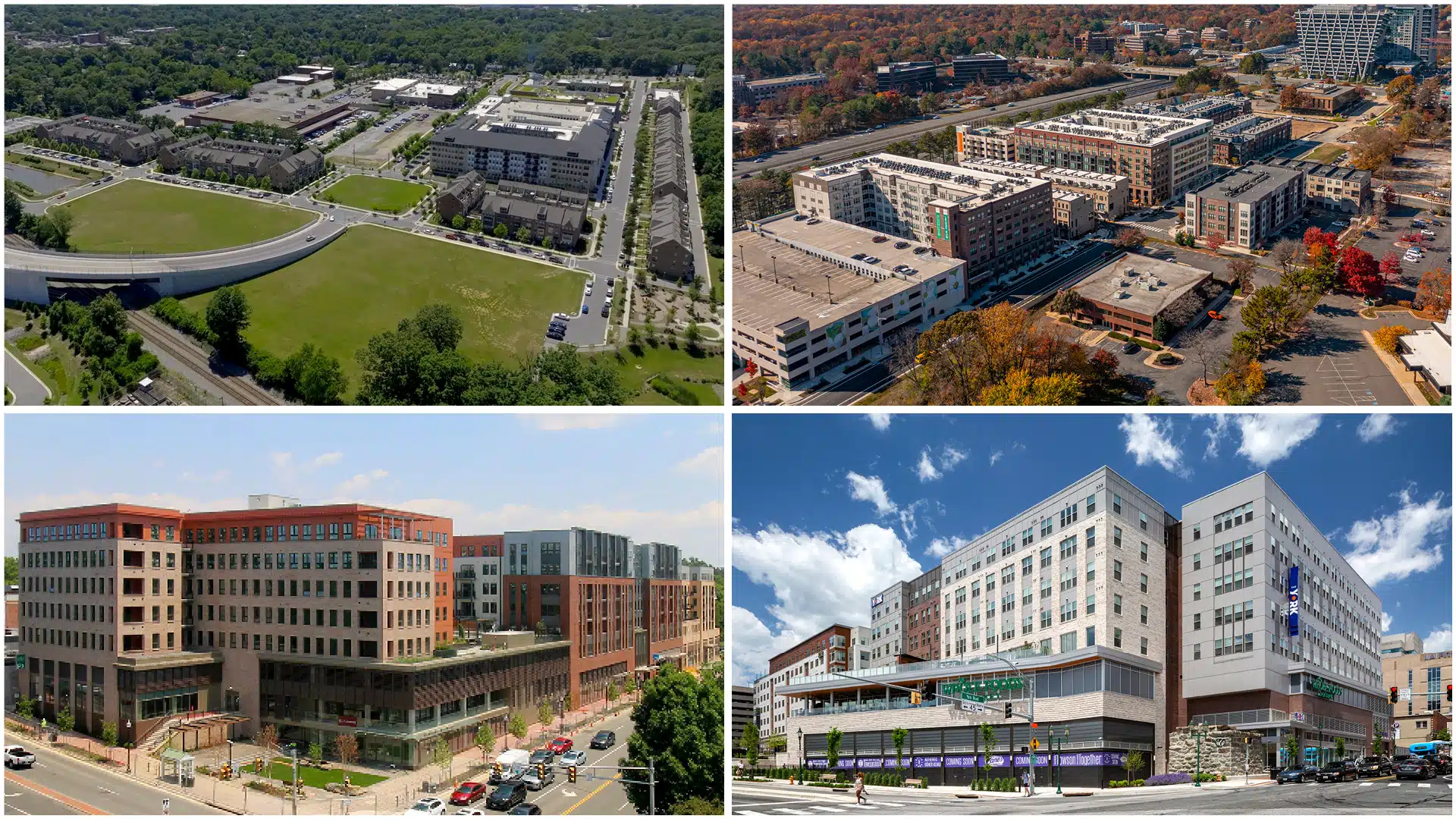 A cross-section of MV+A multifamily projects, each addressing a variety of issues including but not limited to: transit-oriented development, densification, urbanizing infill, apartment type diversity, right-sizing retail and commercial programming, green space amenities, walkability and live-work-play.
Clockwise from upper left: Riverdale Park Station | Riverdale Park, MD, Faraday Park | Reston, VA, The York | Towson, MD, and Broad + Washington | Falls Church, VA.
A Fragmented Landscape
The DMV region is home to two states, one federal district, and more than a dozen local jurisdictions with independent planning authorities, permitting processes, and political leadership. Zoning codes, funding structures, and policy timelines differ widely across county and city lines, resulting in a patchwork of regulations that too often work at cross-purposes. Meanwhile, the issues we face—rising rents, land constraints, displacement, homelessness—do not respect these borders.
Residents commute across jurisdictions daily. Employers draw talent from multiple counties. Infrastructure systems cross state lines. Yet housing development, financing, and regulation are frequently considered in isolation. This disjointed approach makes it harder to scale promising solutions or respond strategically to emerging trends.
To be clear, regionalism does not mean uniformity. It does not suggest erasing local identity or imposing a single vision across diverse communities. Rather, a regional framework allows for strategic alignment—setting shared goals, exchanging data, coordinating investments, and identifying policy tools that can be adapted to local contexts. It is about cultivating a common language and common purpose across a complex landscape.
The Call for Broader Stakeholder Participation
In many housing discussions, the usual suspects are present: city staff, developers, planners, architects, and advocacy groups. These stakeholders play vital roles, but alone they cannot deliver the scale of change required. If we are to address the structural roots of our housing crisis—and not merely the symptoms—we need to widen the circle.
This includes institutions that may not always see themselves as part of the housing system: universities, healthcare providers, cultural organizations, and major employers, to name a few. These anchor institutions often control large parcels of land and bring deep community roots. They also face workforce challenges tied directly to housing affordability. When employees cannot afford to live near their place of work, productivity, retention, and community investment suffer.
Financial stakeholders must also be engaged early and often. Too many promising projects stall due to opaque financing tools or risk-averse underwriting practices. Meanwhile, landlords—who collectively provide more housing than any single sector—are often treated as adversaries rather than potential collaborators. Their participation is critical, particularly in conversations about housing preservation, tenant protections, and the economics of maintenance and reinvestment.
And most importantly, residents themselves—especially those in historically underinvested communities—must be included as active participants in shaping their housing future. Engagement cannot be limited to public comment periods or design charrettes. It must be ongoing, reciprocal, and grounded in lived experience. Only then can we craft housing policies that are responsive, equitable, and effective.
 In 2006, Leesburg, VA created the Crescent Design District [CDD] to incentivize mixed-use development promoting increased density, expanded public space programs, and walkability—all in line with the historic urban fabric of its downtown. For close to 15-years, no projects managed to move forward until our client Keene Enterprises made a concerted effort to work closely with the Leesburg Planning Commission to shepherd the conversion of a 1960’s, 18-acre shopping center into a mixed-use community development.
MV+A led the project team through a process involving over 30 meetings with planning staff, commissioners, and other project stakeholders resulting in 45 modifications to the original CDD design guidelines. The project is currently moving forward with Phase I underway. This project is a testament to what can be achieved through robust collaboration.
A Systems-Level Challenge
Too often, housing is treated as a stand-alone policy domain, disconnected from related systems that influence its success or failure. In reality, housing is deeply interwoven with transportation, economic development, education, public health, and environmental resilience. Addressing one without the others leads to incomplete or unsustainable outcomes.
Consider the relationship between housing and transit. High-capacity transportation investments require certain thresholds of residential density to be viable, yet restrictive zoning around transit stations limits housing production in precisely the places where it is most needed. Or take healthcare: stable housing is among the most effective predictors of positive health outcomes, yet health systems rarely factor housing supply into their community benefit strategies.
Similarly, efforts to reduce greenhouse gas emissions cannot succeed without tackling the spatial patterns of housing. Sprawl development increases car dependency and infrastructure costs, while compact, infill housing reduces per capita energy use and supports walkable, transit-connected neighborhoods. The intersections are clear—but aligning incentives across sectors remains a persistent challenge.
A systems-level approach does not mean every agency or institution must become a housing expert. It means recognizing how their decisions affect the housing landscape—and inviting them to help shape it. Cross-sector partnerships, integrated data tools, and shared performance metrics can help bridge these gaps and support coordinated action.
The Importance of Data: Seen and Unseen
Every planning decision begins with data, and yet, in the housing sector, our data infrastructure remains surprisingly uneven. At the regional level, core indicators such as housing inventory, vacancy rates, and affordability gaps are often compiled using inconsistent definitions, timeframes, or methodologies. This makes it difficult to assess need, allocate resources, or evaluate impact across jurisdictions.
Beyond traditional metrics, there is an urgent need to surface underreported dimensions of the housing market: informal housing arrangements, unpermitted conversions, short-term rentals, and second-home vacancies. These “hidden” units can distort demand calculations and obscure important dynamics related to displacement and neighborhood change.
Innovative mapping tools and AI-driven modeling can help address some of these gaps—but only if data is shared, maintained, and trusted across boundaries. A regional approach offers the opportunity to build a more robust and transparent data ecosystem, one that supports nuanced analysis and targeted interventions.
 While identifying and aggregating ‘hidden’ data presents a formidable challenge to addressing the housing crisis, utilizing appropriate and concomitant visualization means and methods is of equal important. Today there are a plethora of free or cost-effective visualization tools readily available.
Innovations in Typology and Delivery
The housing conversation often revolves around units: how many, where, and at what price point. But the form those units take—and the systems used to deliver them—are equally critical.
The earlier briefs in this series highlighted several [re]emerging typologies: Missing Middle Housing, Point Access Block Buildings, and adaptive reuse of underutilized commercial properties. Each of these strategies offers potential for increasing housing supply without overwhelming infrastructure or community character. Yet they also face barriers—from outdated codes to community resistance—that can only be addressed through sustained, cross-jurisdictional coordination.
Innovation in construction is similarly promising. Modular and manufactured / prefabricated systems, mass timber, and passive house standards can reduce costs, speed up timelines, and minimize environmental impact. But realizing these benefits at scale requires not just technical know-how, but regulatory reform, workforce development, and new financing models.
No single jurisdiction can test and scale all these innovations alone. A regional platform can facilitate shared pilots, performance benchmarking, and the diffusion of best practices. It can help normalize new approaches by building collective confidence in their viability and value.
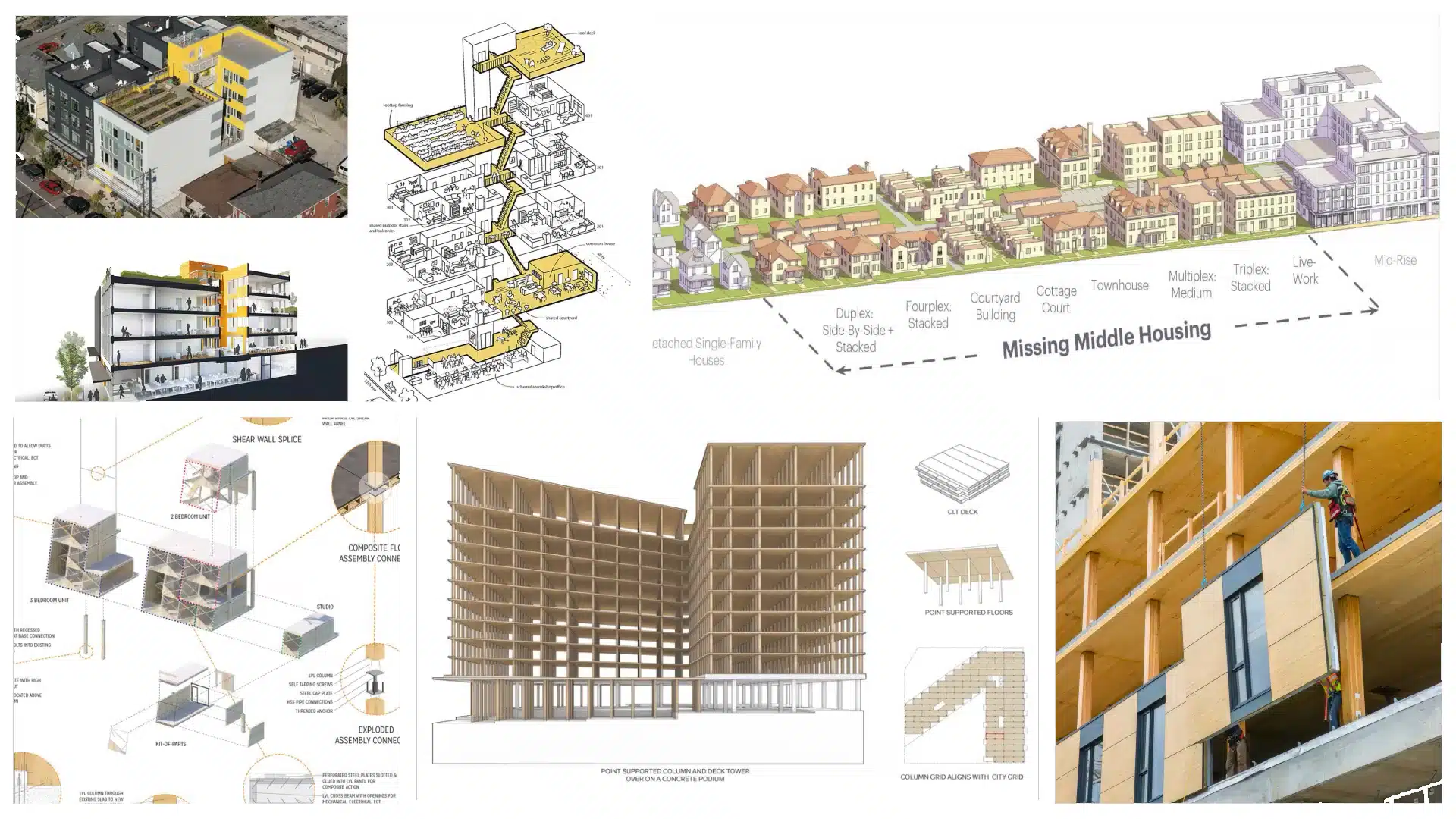 New (and not-so-new) innovations offering significant potential in addressing the the housing crisis; clockwise from top left: Point Access Block Multifamily, Missing Middle Housing, Pre-Fab / Manufactured Building Components, Mass Timber, and Modular Construction.
Cross-Jurisdictional Coordination: From Challenge to Opportunity
The diversity of the DMV region—geographic, political, and cultural—is often cited as a challenge to coordination. In truth, it is one of our greatest assets. Different jurisdictions bring different strengths: density in the District, institutional depth and experience in Maryland, development opportunity in Virginia. What is needed is not homogeneity, but alignment.
Efforts like the Metropolitan Washington Council of Governments (MWCOG) and the Regional Housing Equity Plan provide a foundation. But more can be done to support the implementation side—where plans translate into projects and policy reforms take root. This includes aligning zoning reforms, sharing permitting innovations, and jointly pursuing federal and philanthropic funding.
A regional strategy can also help address timing mismatches. When one jurisdiction is ahead of the curve, it can serve as a proving ground for others. When another lags, it can benefit from the lessons already learned. The goal is not to move at the same pace, but in the same direction.
Federal Presence and Regional Resilience
The DMV is uniquely shaped by the federal government—not just as a landholder, but as a workforce anchor, policy influencer, and economic engine. As federal office occupancy patterns shift post-pandemic, opportunities for adaptive reuse and new public-private models are expanding. But so too are fiscal pressures on local budgets and land use strategies.
A regional approach can help maximize federal engagement: identifying priority sites for housing, aligning infrastructure investments with housing goals, and coordinating responses to market shifts. It also strengthens the case for federal policy reforms that support regional housing efforts—such as changes to building codes, financing tools, and data standards.
Conclusion: A Shared Responsibility
The housing crisis is not an isolated market failure. It is the cumulative outcome of decades of decisions—large and small—across government, industry, and civil society. As such, no single sector can solve it alone. But together, we can build the tools, frameworks, and partnerships required to chart a new course.
A regional approach is not just the most practical path forward—it is the only one that aligns with the interconnected nature of the challenges we face. It invites us to think bigger, act more strategically, and measure success not just in units built, but in communities strengthened.
The moment is urgent, but the potential is vast. With the right partners at the table and a commitment to shared purpose, the DMV can lead the way in redefining what it means to plan, build, and govern for housing in the 21st century.
