FROM COMMUTE TO COMMUNITY | Building Complete Places Along Northern Virginia’s Transit Corridors
In 1991, journalist Joel Garreau argued that America’s future would not be found in its historic downtowns, but in a new generation of suburban employment centers he called Edge Cities. Places like Tysons, Reston, Herndon, and the Dulles Corridor had evolved beyond bedroom communities into powerful economic engines, attracting jobs, investment, and millions of square feet of commercial development.
Garreau’s observations proved remarkably prescient. Yet they described only the beginning of the story.
Today, Northern Virginia is entering a new phase of evolution. Rather than expanding outward, communities are increasingly reinvesting inward—transforming aging shopping centers, office parks, and commercial corridors into vibrant mixed-use neighborhoods where people can live, work, shop, and gather.
For more than four decades, MV+A has collaborated with developers, municipalities, and retailers throughout Northern Virginia to help shape that transformation. From grocery-anchored retail centers and transit-oriented districts to large-scale mixed-use communities, our work has focused on creating places designed around people rather than automobiles.
While every project responds to its own market and community, they share a common objective: transforming destinations built for the daily commute into complete places designed for everyday life.
 Clockwise from top left: Halley Rise | Reston, VA; Virginia Village | Leesburg, VA; Tysons Dulles Plaza | Tysons, VA; Cascades Marketplace | Sterling, VA.
THE ECONOMICS OF ARRIVAL
Northern Virginia’s remarkable growth was once driven by access. Highways, Dulles International Airport, and a rapidly expanding employment base transformed once-rural communities into some of the nation’s most successful suburban markets. Today, success is measured differently. The region’s most competitive places combine housing, employment, retail, recreation, and public space into environments that attract investment, talent, and long-term community life.
The opportunity now lies in reinvesting in what already exists. Some properties are well suited for comprehensive mixed-use redevelopment, while others benefit from strategic modernization that strengthens their long-term value through improved architecture, public spaces, pedestrian connections, and selective infill.
Across Northern Virginia, MV+A has helped guide this evolution. Faraday Park reimagines a former office campus in Reston as a vibrant mixed-use neighborhood responding to changing workplace patterns. Virginia Village demonstrates how collaborative planning can transform an aging shopping center into a walkable district that complements downtown Leesburg. Tysons Dulles Plaza reflects the continued maturation of one of the region’s premier commercial corridors, while Halley Rise and Cascades Marketplace illustrate the potential of large-scale redevelopment to create new mixed-use destinations.
Although each project responds to different circumstances, they share a common objective: creating lasting economic value by strengthening the places that already matter.
 Faraday Park | Reston, VA for Rooney Properties.
 Virginia Village | Leesburg, VA for Kean Enterprises.
 Halley Rise | Reston, VA for Brookfield Properties.
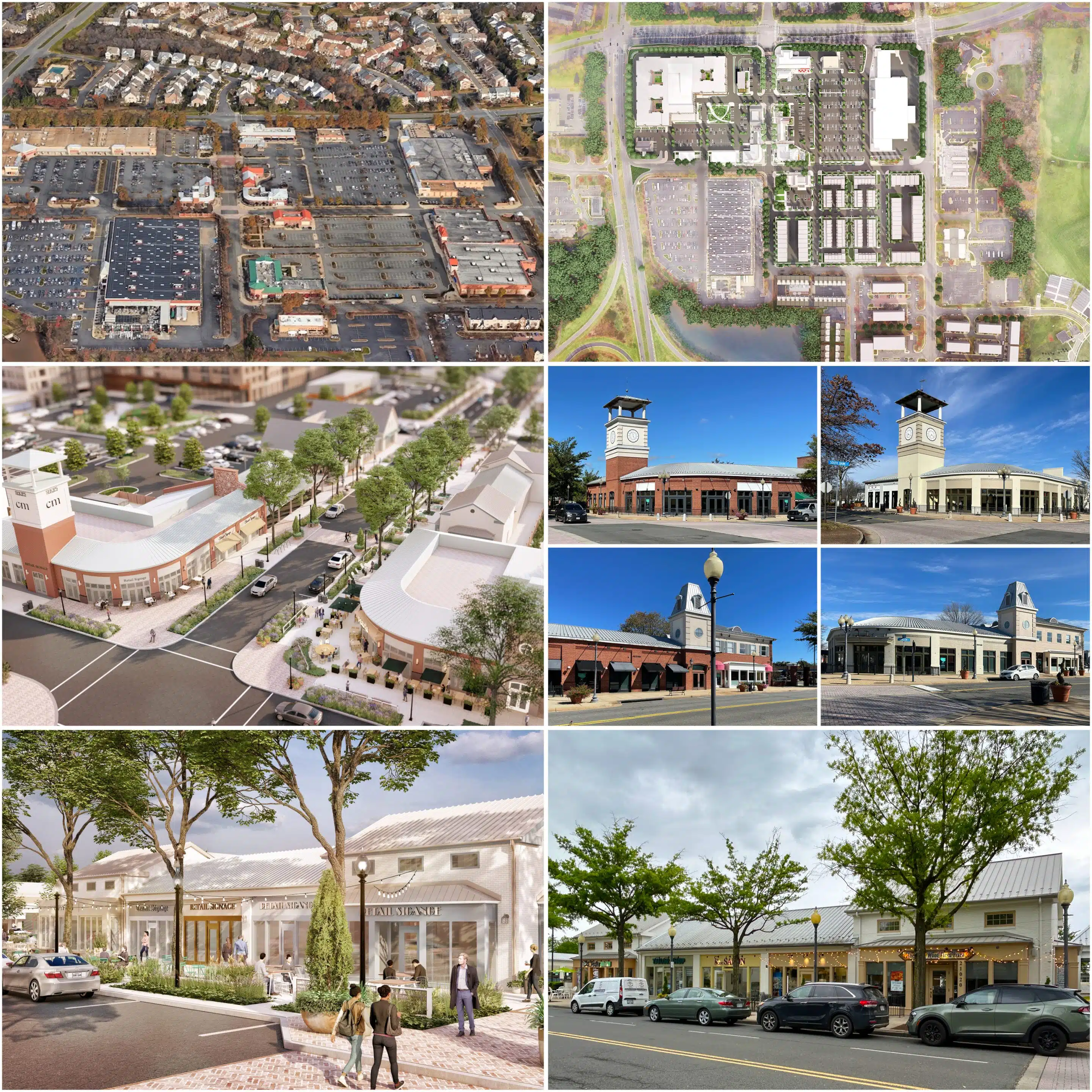 Cascades Marketplace | Sterling, VA for Willard Retail.
THE NEW COMMUNITY ANCHORS
The suburban shopping center once revolved around a single destination. Today, successful communities are organized around a network of complementary places that generate activity throughout the day. Grocery stores remain important anchors, but they now work alongside housing, restaurants, workplaces, parks, entertainment, and civic spaces to create the rhythm of everyday life.
Few retailers have influenced this evolution more than Whole Foods Market. Over more than three decades, MV+A has partnered with Whole Foods as the brand evolved from neighborhood grocery stores into increasingly sophisticated urban and mixed-use environments.
Broad + Washington in Falls Church illustrates this transformation. Anchored by Whole Foods Market, the redevelopment of a former municipal parking lot combines new housing, neighborhood retail, the Creative Cauldron Theatre, and a central public plaza into a vibrant civic destination where each use reinforces the others.
The same pattern can be seen across Northern Virginia. At Reston Town Center and The Boro in Tysons, Whole Foods Market functions as one component within larger mixed-use districts where residential, office, hospitality, retail, and public spaces work together to create complete neighborhoods.
Whether designing around Whole Foods, Wegmans, specialty markets, or other destination retailers, MV+A’s objective remains the same: creating places where commerce supports community and individual destinations become stronger together.
 Clockwise from top left: Wholes Foods Market Falls Church, VA; Mclean, VA; Arlington, VA; Reston, VA..
CONNECTING COMMUNITIES
Great communities are defined not simply by what they contain, but by how well they connect. Streets, sidewalks, parks, transit, housing, retail, and civic spaces must work together to create places that encourage walking, foster interaction, and support everyday life.
Across Northern Virginia, MV+A has applied these principles at a variety of scales. 1001 South Glebe Road transforms a former auto-oriented parcel into a walkable mixed-use destination that strengthens a key Arlington intersection. Isaac Newton Square integrates new multifamily housing with existing neighborhoods, mature woodland, and adjacent parkland through generous pedestrian connections and thoughtfully scaled open spaces. In Herndon, Exchange Place supports Metro expansion while reinforcing the transition from suburban office parks to vibrant mixed-use neighborhoods. And along Columbia Pike, aging commercial properties are being reimagined as more connected, walkable communities.
Although each project is unique, they reflect a shared philosophy: stronger connections create stronger communities. When buildings, public spaces, mobility, and commerce work together, neighborhoods become more resilient, more valuable, and more enjoyable places to live.
 Clockwise from top left: 1001 S Glebe Road | Arlington, VA for 1001 S Glebe Road, LLC; Isaac Newton Square | Reston, VA for JLB Partners; Exchange Place | Herndon, VA for Rooney Properties; 2600 Columbia Pike | Arlington, VA for Kennedy Wilson.
WHAT COMES NEXT?
Northern Virginia’s greatest era of development may still lie ahead—not because the region will continue to expand outward, but because it possesses an extraordinary opportunity to reinvent what already exists. The next generation of growth will be shaped by the thoughtful transformation of established places into more connected, resilient, and complete communities.
For more than four decades, MV+A has partnered with clients across Northern Virginia to help guide that evolution—from grocery-anchored retail centers and suburban retrofit to transit-oriented districts and mixed-use town centers. Across every project, one principle remains constant: lasting value is created by understanding not only what a place is today, but what it has the potential to become.
Thirty-five years after Edge City challenged us to rethink the American suburb, Northern Virginia is once again redefining what suburban success can look like. The story is no longer one of destinations built for the daily commute, but of communities designed for everyday life. That is the future MV+A is helping to shape—one project, one neighborhood, and one community at a time.