
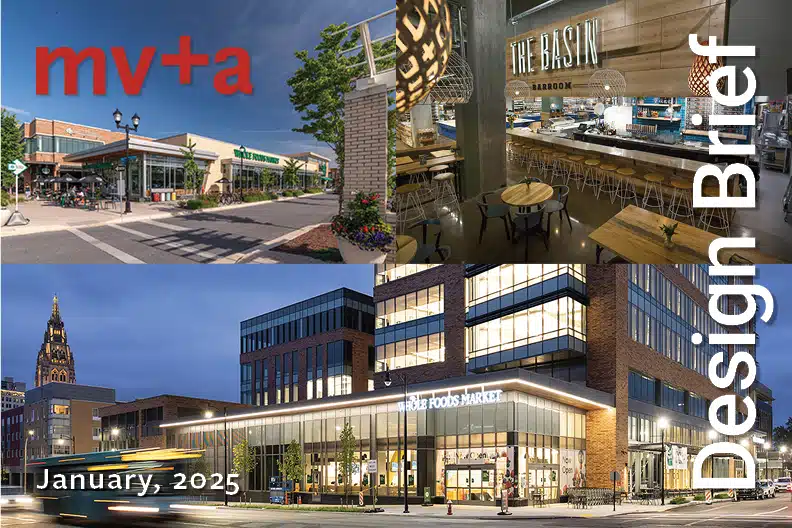
ALL THINGS WHOLE FOODS MARKET
While it’s no secret that Whole Foods Market is one of our most longstanding clients, what many people don’t realize is just how wide ranging the extent of our project services have been as well as the extent of our geographic market reach.
To date MV+A has worked on well over 100 projects for Whole Foods Market. For the over 65 new stores we have been involved with across 16 states, MV+A has been the architect of record for 58 stores and the design architect for 48 stores. We have been responsible for designing the building shell for 44 stores and responsible for the interior design / tenant improvements for 60 stores.
 2025 | MV+A – WFM Geographic Reach
Over the past 30-years, the design of grocery stores has evolved dramatically and Whole Foods Market has probably had more influence in this arena than any other grocery retailer. Once upon a time, grocery stores were the most utilitarian of building types, usually accompanied by surface parking lots—even in urban locations.
Nowadays, depending on any given site context, grocery stores can present some of the most complex challenges imaginable—from mechanical requirements, structured parking, and service access to contending with challenging site conditions and ancillary mixed-use program requirements. And that’s the stuff shoppers neither notice nor care about; the more important challenge is engaging the customer, creating a palpable brand presence and experience—inside and out. And by ‘out’, we mean experience that will resonate throughout the community and beyond.
No two Whole Foods Markets are the same. More than any other grocery retailer, Whole Foods Market does a remarkable job in designing their stores around the neighborhoods and communities they serve. Within this context, we tend to place our projects within three categories of store types: retail center stores, stand-alone stores, and mixed-use anchor stores—typically with multistory commercial or multifamily above. Of course there are many permutations across these categories, after all, no two stores are the same.
Reimagining Retail Centers
Not unlike the grocery renaissance of the last three decades, commercial retail development has undergone significant transformation. Once seen as losing ground to e-commerce, brick-and-mortar retail is now evolving into vibrant, mixed-use hubs that prioritize walkability and community engagement. Retail is no longer just about transactions—it’s about creating dynamic, human-centered spaces that enhance quality of life.
‘Quality of life’ is synonymous with the Whole Foods Market brand and the value they bring to any given retail development is substantial. From the initial building approach to checking out, shoppers can always expect an experience that promotes and reinforces ‘quality’: rich, engaging material and color palettes, sumptuous lighting—including optimized daylighting when possible, ample amenities (cafes, food bars, dining areas, and more), all providing the framework to showcase the fresh bounty that fills the store. The client design team will often connect their approach to natural foods with the notion of integrity—to natural building materials like raw stone, brick, wood, concrete, and avoid artificial materials and paneling.
With all of this, it’s no wonder that so many Whole foods Market stores have become the central destination of so many retail centers in this emergent retail environment.

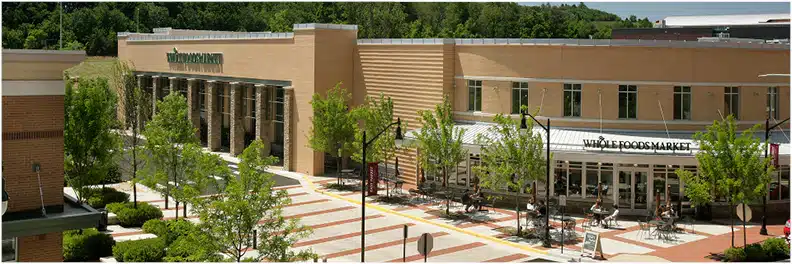
 Spring House Village | Spring House, PA
Working within a retail center context, any number of scenarios may arise. When a new store is part of a larger center repositioning effort, our design may end up driving the aesthetic direction for the entire development. When a center already has a successful design direction, it’s simply a matter of responding sensitively to the right cues. Still other times, a given development may be adrift without a meaningful ‘marquee’ or signature building to anchor it. In these instances our design needs to provide the necessary main attraction.
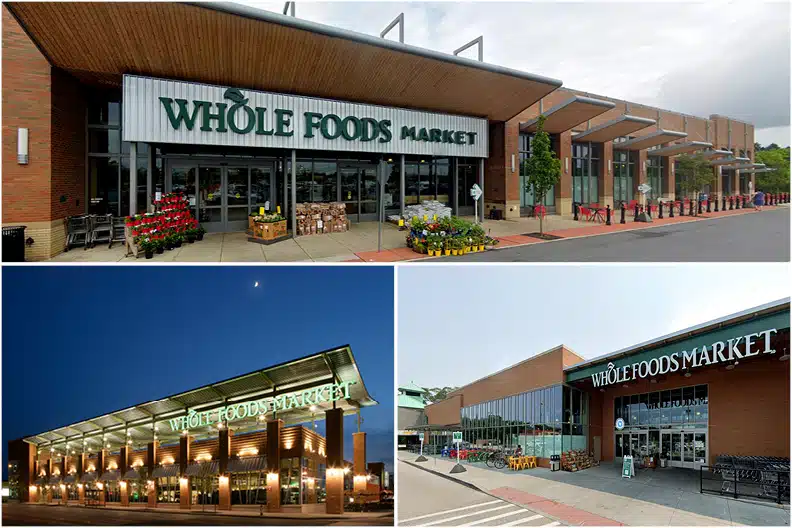
 Clockwise from Top: Allentown, PA | Rocky River, OH | Fairfax, VA | Cedar Center, OH
Signature Stand-Alone Stores
Occasionally we get the opportunity to design a Whole Foods Market within an existing community with well established development patterns and civic identity. Often enough, there are challenges with the site and / or with the surrounding context that provide the best opportunities for effectively integrating the new store within the existing community. Our project for Wynnewood, PA goes a long way in demonstrating this notion.
 Whole Foods Market | Wynnewood, PA
The store at Wynnewood sits upon a small site perched high above the adjacent street. To solve the parking challenges, MV+A provided a hybrid solution where half of the parking is located in a high surface lot at the main upper store level, while the remainder is below the store accessed at the lower street level.
Although the store sits high above the adjacent street at the upper surface parking level, MV+A worked with Whole Foods to create a substantial lower entrance space that connects pedestrians at the street with customers parking at the lower level, and simple vertical circulation to the main level.
The space is activated by a pub, café space, and outdoor seating. Architecturally, the store addresses the street with ample glass that becomes a beacon at night while a strong canopy marks the entrance for those parking at the upper surface level.
 Whole Foods Market | Wynnewood, PA
Elevating the Urban Anchor
Large-format retail in multi-story mixed-use use may not exactly be new, but large-format grocery in multi-story mixed-use is most definitely a thing of the more recent past. Our first multi-story mixed-use anchor project for Whole Foods Market was in 2004 in Alexandria, VA. This project was the first mixed-use, stick-built multifamily anchor store for Whole Foods Market as well as the first project of its kind in the Greater Washington region having been approved with code modifications to the old BOCA Codes prior to Alexandria’s formal adoption of IBC.
The modifications introduced the concept of a horizontal fire wall, something never allowed under the BOCA codes. The horizontal firewall, the basis for podium construction, allowed us to switch construction types above the second floor podium, introducing Type V wood stick-built construction. It was the first stick-built multifamily project for the Developer, the JBG Companies, as well as for the builder, Clark Construction. Additionally, it was the first such project in the region with a major grocery tenant anchoring a mixed-use, multifamily podium project.
 Clockwise from Top Left: Washington, DC | East Liberty, PA | Tysons, VA | Philadelphia, PA
There is a significant correlation between the planning and design of large format, grocery-anchored, mixed-use residential buildings within dense urban areas and the viability of livable, sustainable and resilient urbanism. Urban areas with mostly residential and office uses will not function without the necessary ‘connective tissue’ and services provided by retail programs—especially easy to reach, walkable, grocery markets.
For The York, in Towson, MD, a site-wide grade change of +/- 25-feet presented distinct challenges to pedestrian and vehicular circulation across the site while affording opportunities to separate and accentuate formal entry sequences for each of the major building programs. What could have been an unthinkable arrangement—a major anchor with an entry 9-feet above the primary fronting street and 8-feet below the secondary service street at the rear—resulted in a considerably enhanced circulation sequence for pedestrians and motorist alike, as well as a host of amenity and service space adjacencies that dramatically improved the quality and efficiency of the store.
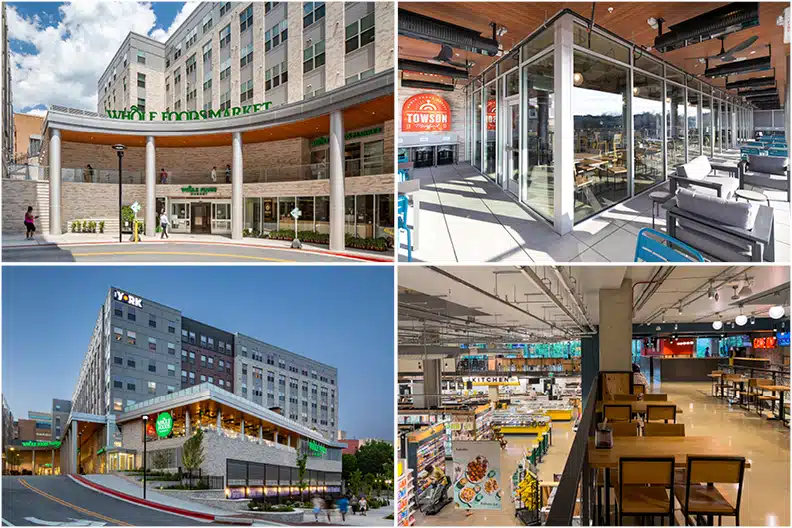 The York | Towson, MD
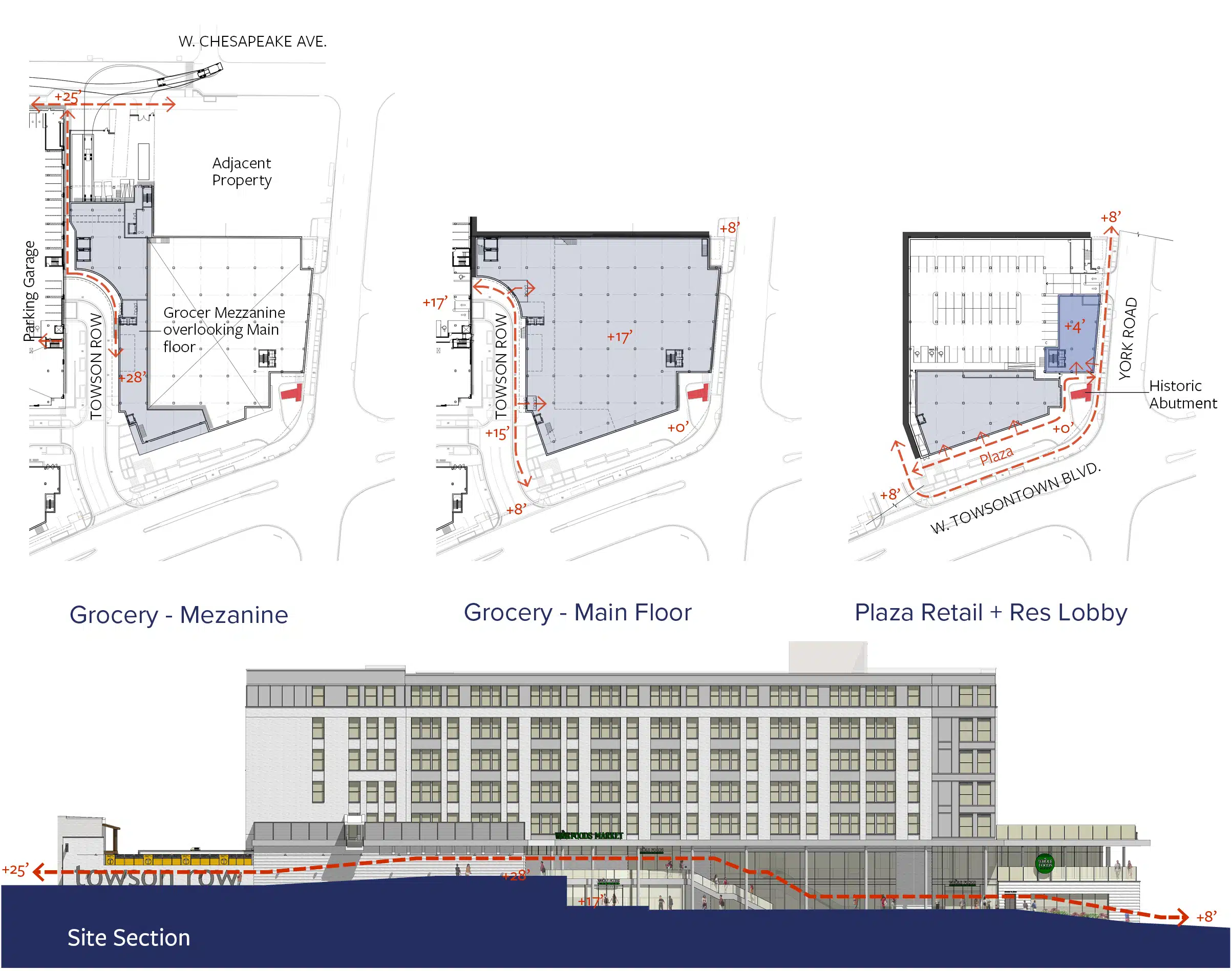 The York | Section Through Whole Foods Market Entry Sequence
Activating Urbanizing Infill
Much of our work at MV+A is focused on was is often referred to as the ‘retrofitting of suburbia’. Often this may involve ‘retrofitting’ existing underutilized commercial retail or office properties but it can also apply to new developments within an ‘urbanizing’ context. Meaning to say, within suburban communities with a mandate to increase density and create more walkable, amenity-rich communities, preferably within proximity to transit options.
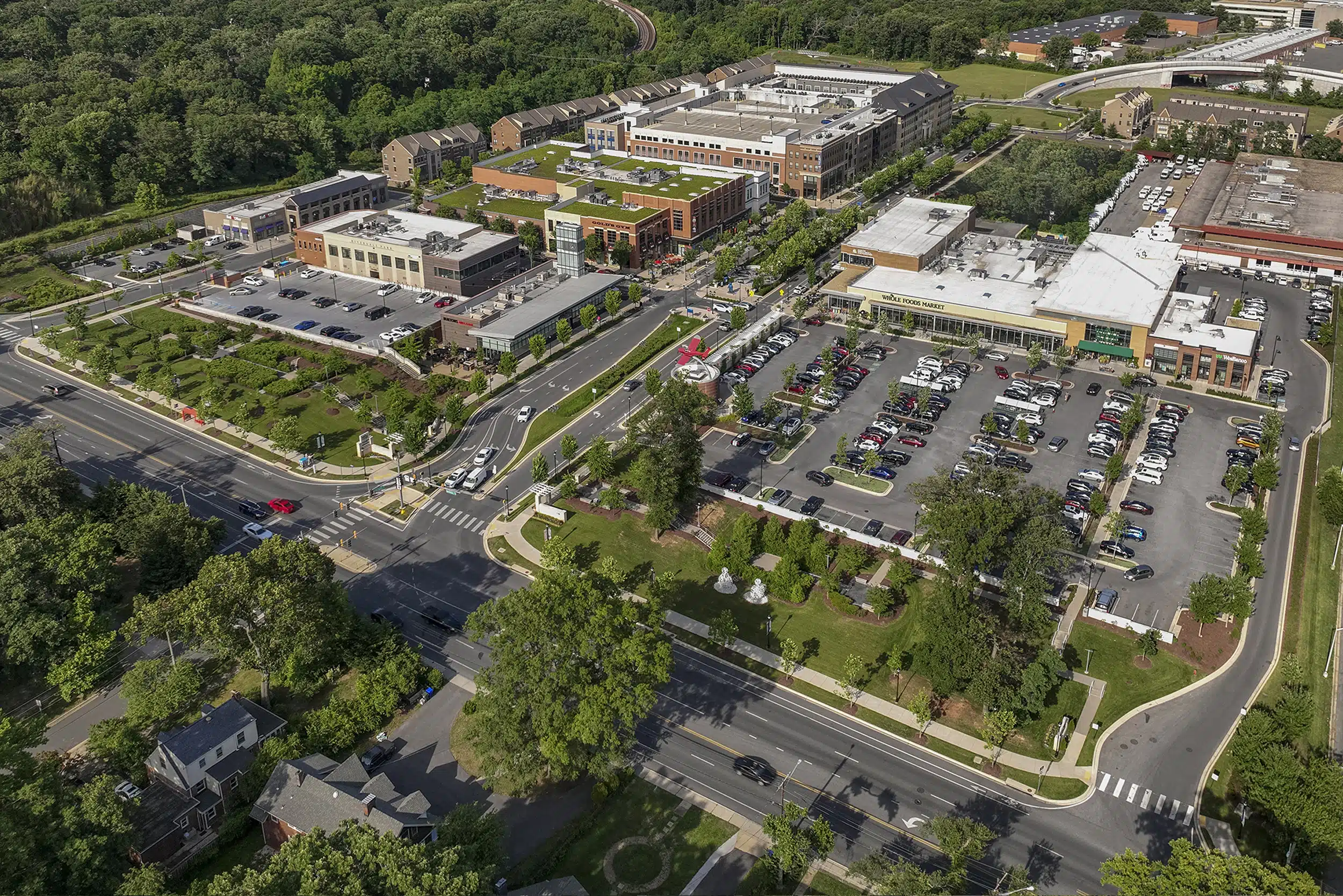
Riverdale Park Station | Riverdale Park, MD
Grocery anchors are critical to the success of many urbanizing infill projects. One of the key challenges of such a project is finding ways to leverage the draw of that important anchor to help activate the remainder of the project.
At Riverdale Park station, MV+A worked to make sure grocery was able to adequately function with clear parking, loading, and strong visibility. But we were also able to integrate the building into the street grid, provide a corner entrance into the store adjacent to the project’s primary retail open space ‘Bear Square’, and connect with adjacent inline retail uses and 2nd level office space. These moves allow for a functional store and a thriving project.
 Riverdale Park Station WFM Store
Whole Foods Market Inside-Out
Collaboration is the hallmark of our process with Whole Foods Market. For our store interiors, MV+A works with the client-side design team to create a remarkable vision as well as bring expertise to the process of developing compelling store experiences. Working closely together, we start from the community we’re serving; surveying the local history, cultural touchstones, and any visual motifs that may resonate throughout the community. From there we identify major themes and subsequent material selections that will reinforce them—always mindful of the aforementioned notion of integrity and authenticity.
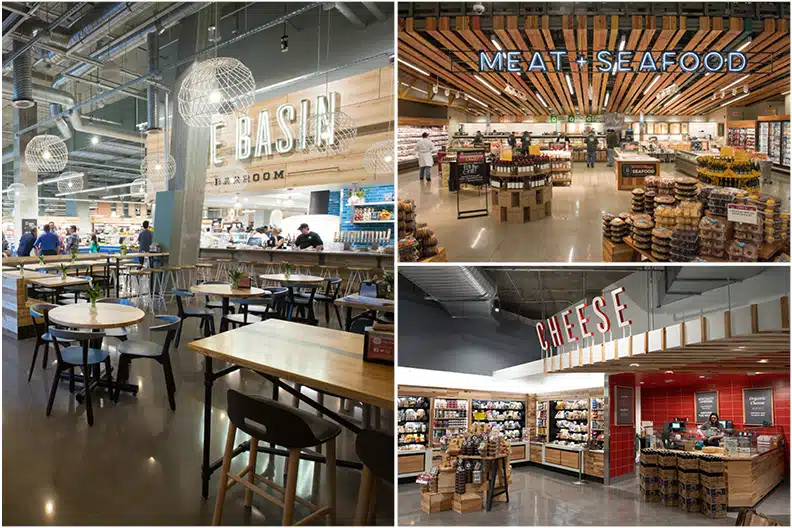 Left: Pentagon City, VA | Right from Top: Rocky River, OH | Tysons, VA
In recent times, the term ‘Third Places’ has come to describe those social surrounds that are separate from Home (first place) and Work (second place) and provide opportunities for broader creative interactions and the potential to become community anchors. Within the retail environment, few destinations have exemplified ‘Third Place’ attributes as effectively as Whole Foods Market. As a retailer, they recognize the significance of this and are committed to ensuring this trend continues.
Subsequently, the times are always changing and Whole Foods Market is constantly innovating to respond to customer’s shopping preferences, evolving technologies, and market trends. These innovations continue to present themselves with the opening of every new or updated store.
 Clockwise from Top Left: Capitol Hill, DC | East Liberty, PA | Newport News. VA | Walter Reed, DC
Always Improving
While our earliest Whole Foods Market projects were more conventional, surface-parked stores, we quickly began working on projects with innovative structured parking, projects in more urban settings, and projects anchoring larger, mixed-use building projects. The multifamily area of our practice has been greatly enhanced by our work with Whole Foods as have our master planning activities.
In point of fact, no aspect of our practice has escaped the influence of the many valuable lessons-learned through our work with this rigorously discerning and quality-obsessed client. Quite simply put, this relationship had made us better architects. The combination of Whole Foods’ excellent market operations with MV+A’s signature design and thoughtful planning has proven time and time again to result in retail success at the highest level.
