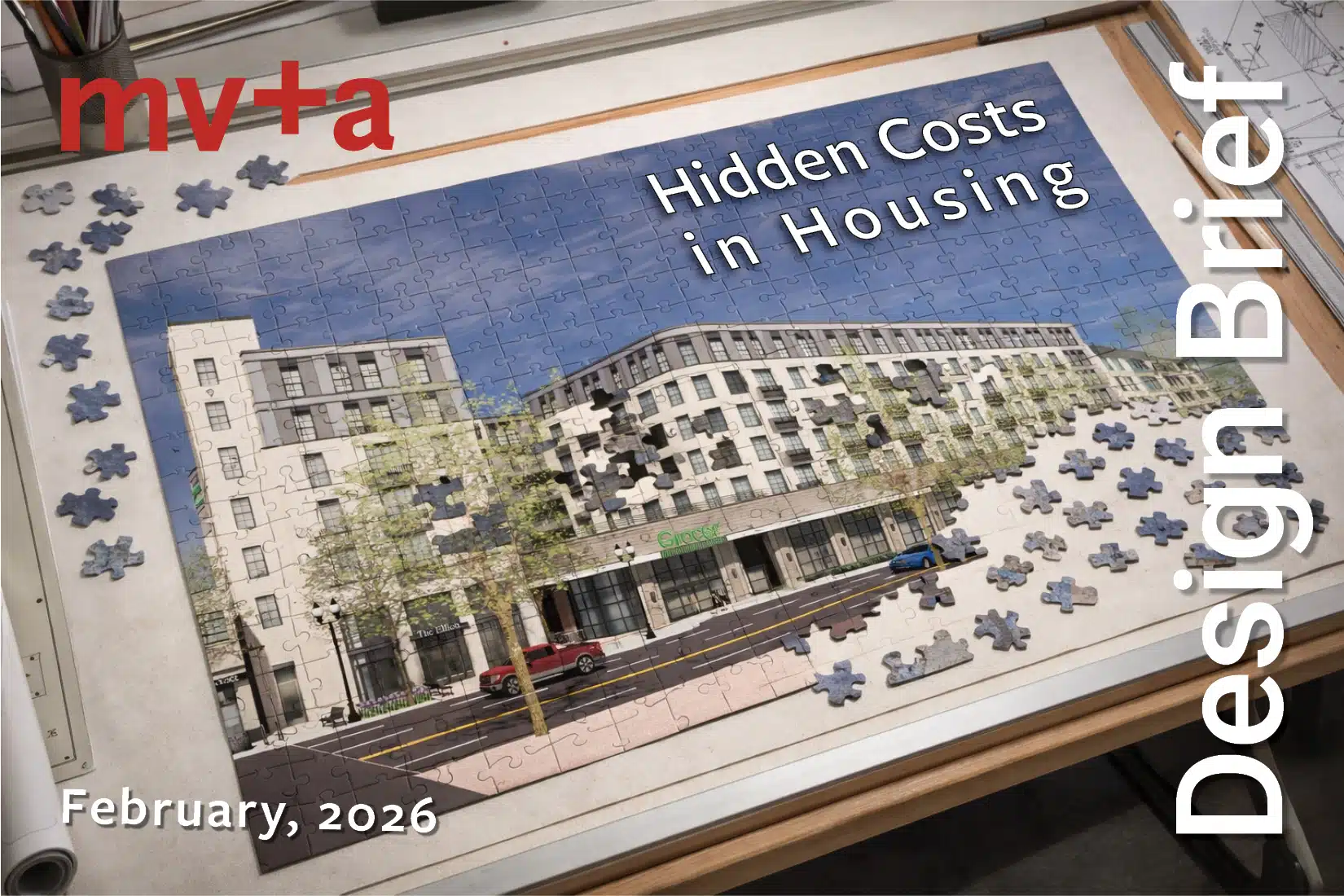
HOUSING FUTURES | Hidden Costs in Multifamily
Public conversations about the cost of multifamily housing tend to gravitate toward the most visible pressures: land values, interest rates, labor shortages, and material volatility. These factors are real and consequential, but they do not fully explain why many otherwise well-located, market-supported housing projects struggle to pencil out—or why the range of feasible housing types continues to narrow.
Less frequently examined are the layered regulatory and procedural requirements that shape projects long before construction pricing is finalized. These requirements rarely appear as single, discrete costs. Instead, they influence building form, reduce efficiency, extend timelines, and increase risk. Over time, they accumulate into what can best be described as hidden costs—costs that are indirect, diffuse, and often invisible to both policymakers and end users, yet deeply influential in determining whether housing is built at all.
This Design Brief introduces a research initiative being spearheaded by MV+A Director of Marketing, Kevin Wegner, as part of his activities as co-chair of the recently formed AIA | DC Housing the Region committee. The initiative is aimed at better understanding these hidden costs, with particular attention to how regulatory intent is translated into design and delivery outcomes. The goal is not to challenge the foundational principles of safety, accessibility, or equity, but to examine how interpretation, redundancy, and process shape cost and feasibility in practice.
What We Mean by “Hidden Costs”
Hidden costs are not line items that appear neatly in a pro forma or construction budget. Instead, they manifest through second- and third-order effects, including:
-
Loss of unit yield due to circulation, egress, or dimensional requirements
-
Inflation of building footprints and structural spans
-
Redundant systems driven by conservative interpretation
-
Extended entitlement and permitting timelines
-
Increased financing, insurance, and contingency premiums
Individually, each requirement may appear reasonable. Collectively, they reshape buildings in ways that reduce efficiency, constrain typological diversity, and ultimately increase the cost of housing delivery. These effects are often most pronounced in multifamily and multi-unit dwelling projects, where margins are thinner and design flexibility is limited.
A Five-Tier Framework
To make these dynamics legible and comparable, the proposed study organizes hidden cost drivers into five consolidated tiers. Each tier represents a distinct layer of influence, while also interacting with the others in ways that compound impact.
The system is optimized to reduce construction and operational costs, increase affordability, and improve long-term asset performance, making it well-suited for public-private partnerships, workforce housing, and mixed-income developments.
Tier 1—Life Safety & Accessibility: Intent, Interpretation, and Design Consequences
Life safety and accessibility requirements form the ethical and legal foundation of contemporary housing design. They are also among the least publicly questioned cost drivers, in part because their underlying goals are non-negotiable. Yet it is precisely this moral clarity that can obscure how interpretation and enforcement affect building form and cost.
Key areas of influence include accessible unit distribution, dimensional clearances in kitchens and bathrooms, egress stair and corridor requirements, and the layering of active and passive fire protection systems. In many cases, conservative or risk-averse interpretations result in spatial inefficiencies that ripple across an entire building—affecting unit mix, structural grids, and façade length.
This tier asks not whether accessibility and safety are necessary, but how performance-based approaches, equivalencies, and adaptability strategies might achieve the same outcomes with fewer unintended consequences for housing supply and affordability.
Tier 2—Building Codes and Technical Standards: When Minimums Become Multipliers
Beyond life safety, a wide array of building codes and technical standards shape cost and feasibility through thresholds and inflection points. Construction type transitions, height limits tied to material systems, and prescriptive energy requirements can dramatically alter structural systems and envelope design with relatively small changes in building massing.
In practice, projects are often designed to avoid triggering more onerous code categories, even when those categories might be technically feasible or socially beneficial. Layered sustainability requirements—sometimes overlapping or inconsistent across jurisdictions—can further complicate compliance, leading to over-specification and redundancy.
This tier examines how technical standards, while individually defensible, collectively steer projects toward narrower design solutions and higher costs, particularly in mid-rise and infill contexts.
Tier 3—Zoning, Entitlements, and Process Risk: Time as a Cost Driver
Zoning and entitlement processes rarely appear in construction budgets, yet they are among the most significant contributors to overall housing cost. Discretionary review processes introduce uncertainty, extend timelines, and increase carrying costs, often forcing design compromises aimed at reducing approval risk rather than improving housing outcomes.
Density limits, height caps, parking minimums, and use restrictions can reduce yield on otherwise viable sites, while prolonged review timelines increase financing costs and exposure to market shifts. In this context, time itself becomes a hidden cost—one that disproportionately affects projects serving middle-income and workforce households.
This tier focuses on how predictability, by-right development, and clearer zoning frameworks can reduce cost without sacrificing community oversight.
Tier 4—Site Infrastructure and External Requirements: Costs Below the Building Line
Increasingly, some of the most significant cost drivers in multifamily housing occur below grade or outside the building envelope altogether. Stormwater management requirements, environmental remediation, fire access geometry, and utility upgrades can rival—or exceed—the cost of vertical construction.
These requirements are often shaped by suburban standards applied to urban or infill contexts, resulting in inefficient land use and increased site work. Off-site improvements and utility capacity upgrades, while essential to broader system performance, frequently function as de facto proffers that are difficult to anticipate early in the design process.
This tier explores how site and infrastructure standards influence feasibility and how more context-sensitive approaches might reduce unnecessary cost burdens.
Tier 5—Financing, Insurance, and Long Term Operations: Risk Premiums and Cost Pass-Throughs
Finally, regulatory and process-related uncertainty feeds directly into financing and insurance costs. Lenders and insurers price perceived risk—whether related to code compliance, entitlement timelines, or operational complexity—into underwriting assumptions, often requiring higher contingencies and returns.
Design decisions made in response to earlier tiers can also have long-term operational implications, affecting maintenance, staffing, and compliance costs over a building’s life cycle. These costs are ultimately passed on to residents through higher rents or fees.
This tier considers how greater regulatory clarity and alignment could reduce perceived risk and improve long-term housing affordability.
Why This Matters for Design Practice
For architects, hidden costs are not abstract policy issues. They appear in everyday design decisions: thicker walls, longer corridors, additional stairs, fewer units, and reduced flexibility. Understanding how these forces interact allows design teams to engage earlier and more strategically—advocating for performance-based solutions, anticipating constraints, and aligning design intent with regulatory reality.
Housing costs do not rise because of any single regulation. They rise because systems accrete without recalibration. Making those systems visible is a necessary first step toward better outcomes.
Stay Tuned…
As noted in the introduction, the content herein is part of a research initiative being conducted by the recently formed AIA | DC Housing the Region committee. We will continue to check-in on this effort and look forward to sharing their findings as it becomes available in upcoming Design Briefs. If you have questions, comments, and / or are interested in contributing to their efforts, please feel free to email the committee at: aiadmvhousing@gmail.com.