

GROCERY FUTURES | Evolving Experiences, Enduring Value
At MV+A, few sectors reflect our design legacy and adaptive strengths as clearly as grocery. From our early work with Giant Food in the 1980s to our decades-long collaboration with Whole Foods Market, we’ve helped shape—and reshape—a sector that has undergone radical transformation. But some things have remained constant: the grocery store remains one of the most essential, resilient, and community-oriented building types in the marketplace. While the broader retail landscape wrestles within stability, grocery-anchored developments remain among the safest and most consistent investment strategies in real estate today.
More than just retail, grocery is social infrastructure—a core part of daily life that never shut down during the pandemic, and continues to evolve with changing consumer expectations, operational models, and neighborhood needs. For us, that evolution is both a challenge and an invitation to rethink how grocery stores function, what they represent, and where they belong.
A SYSTEM OF RHYTHMS: Today’s Grocery Landscape
While the grocery sector is often categorized by store size, a more useful distinction lies in how each store type fits into the rhythm of daily life—its cadence, purpose, and connection to place. Today’s consumers curate their grocery lives across multiple formats, driven by need, routine, and brand preference. Think of it not as a hierarchy, but as an ecosystem.
Warehouse Clubs | 100K+ SF
These are destination shopping experiences best exemplified by Costco and Sam’s Club, visited perhaps once a month. Built for bulk purchasing, they emphasize price, efficiency, and logistics—often in large, utilitarian buildings on auto-oriented sites. Increasingly, even these operators are exploring ways to integrate into mixed-use environments where architecture, circulation, and public realm must work harder.
Regional Supermarkets / Superstores | 65K – 85K SF
Aimed at a broad, one-stop-shop experience, these stores typically serve a wide trade area and offer extensive product variety—from pantry staples to prepared meals, sometimes complemented by in-store dining or specialty counters. Wegmans has a major market share in this arena. They are evolving from their suburban roots to urban and infill locations, where design innovation is needed to address site constraints, parking, access, and vertical integration.
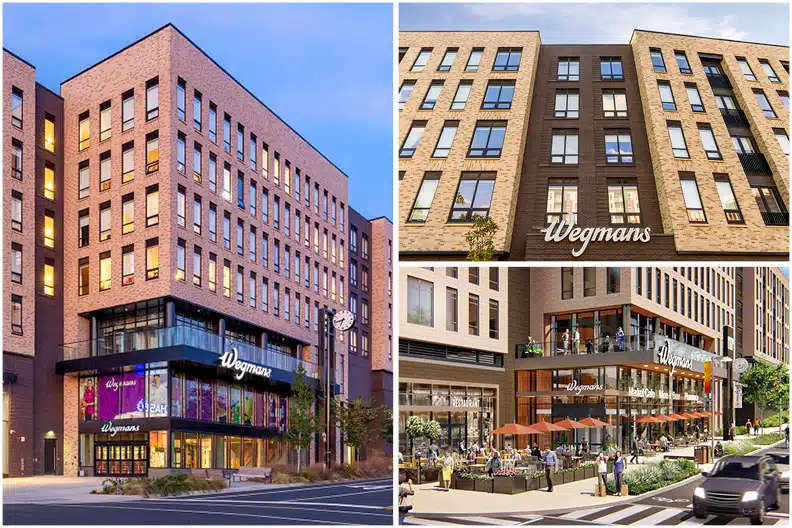 Wegmans at Halley Rise | Reston, VA
Local Supermarkets | 35K – 65K SF
These are the weekly anchors of neighborhood shopping—providing most household needs while being easier to integrate into mixed-use developments and denser contexts. They can be found in every community from traditional suburbs and urbanizing metro-neighborhoods to urban districts. They support frequent, flexible trips. Their brand identities span a genuine range of shopper demographics, from Whole Food Market to Safeway. Their role extends beyond commerce: they anchor community identity and offer opportunities to reflect neighborhood character in both exterior and interior design.
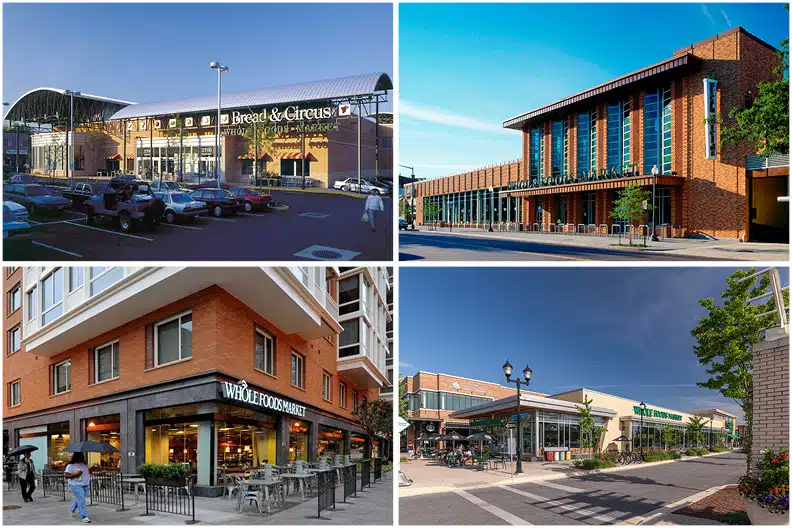 From traditional surface-parked stores to urban infill, urban anchors, and urbanizing town centers, MV+A has worked with Whole Foods Market to adapt and innovate in response to evolving market conditions.
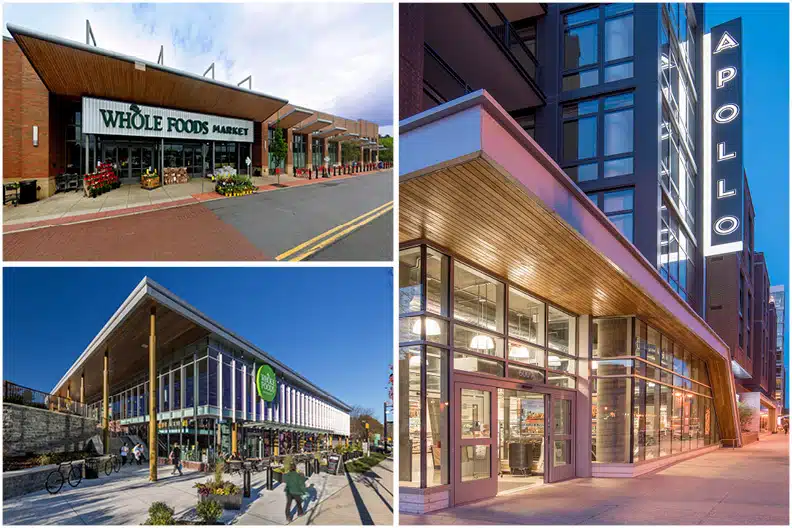 No two Whole Foods Markets are the same. More than any other grocery retailer, Whole Foods Market does a remarkable job in designing their stores around the neighborhoods and communities they serve.
Neighborhood Specialty / Discount Grocers | 12K – 35K SF
These stores excel at a focused offering—whether that’s value pricing, organic produce, or curated favorites. Think Trader Joe’s, Aldi, Lidl, MOM’s, Sprouts. They thrive in high-foot-traffic areas and adaptive reuse sites, where compact footprints, quick turnover, and loyal followings demand precise design and operational efficiency.
Grab and Go | <15K SF
From corner shops to small-format concepts like Amazon Go, these are hyper-convenient destinations for quick stops and immediate needs. Often embedded in transit hubs, office districts, or residential ground floors, they trade depth of selection for speed, proximity, and flexibility.
A Layered Cadence
For many households, the rhythm is a blend—monthly bulk runs, weekly supermarket visits, frequent specialty stops, and daily quick trips. This layered pattern shapes the design and planning challenges we face: integrating multiple formats into diverse urban and suburban contexts, right-sizing footprints, planning for e-commerce fulfillment, and supporting active street life.
“I go to Costco once every 4–6 weeks, Trader Joe’s every other week, Whole Foods at least once a week–sometimes twice, and to my farmers market every Saturday. And, of course, I can always depend on Streets Market for quick fixes and off-hour needs.”
— MV+A team member
The task for designers and planners is to create grocery environments that respond to both the business model and the neighborhood—where operational efficiency, brand identity, customer loyalty, and community presence can all coexist.
FROM UTILITY TO IDENTITY: Designing for Experience
What began as fluorescent-lit boxes surrounded by asphalt has evolved into something far more intentional. Today’s leading grocery environments blend functionality with brand storytelling and architectural expression. Clients aren’t just asking how to maximize shelf space—they’re asking how to:
-
Integrate pickup zones, cafés, or public seating
-
Express sustainability through natural materials and daylighting
-
Translate neighborhood character into exterior and interior design forms and motifs
-
Reinforce brand identity through a welcoming, intuitive entry experience
Grocery design today is about brand identity, customer loyalty, public life, and flexibility—a spatial response to shifting retail expectations and evolving user behavior. As in-person shopping reasserts its value post-COVID, architecture plays an even bigger role in signaling safety, delight, and community connection.
 Whole Foods Market has been at the leading edge in designing their stores for meaningful customer experiences with spatially sophisticated environments that reflect brand identity, neighborhood character, and consumer values. MV+A has been instrumental in this evolution working closely with WFM to innovate many store ‘firsts’ that have gone on to become store ‘standards’.
MV+A’S ROLE: Navigating Complexity with Clarity
As the grocery sector has diversified, so too has our approach. We’ve designed everything from urban Whole Foods Market flagships and adaptive reuse conversions, to structured-parking Wegmans and neighborhood-scaled markets in dense walkable districts. Our work is built on the belief that grocery is never a one-size-fits-all proposition. Each brand, site, and community deserves a tailored solution.
Whether solving for constrained footprints, loading dock challenges, or community engagement, we bring decades of experience to each new project. And with well over 100 grocery stores across our portfolio, we’ve seen—and solved for—it all.
 At MV+A we have planned and designed for just about every major national grocery brand including Giant, Walmart, Safeway, Harris Teeter, Target, and Trader Joe’s. Current planning and design projects include projects for Publix, Aldi, Lidl, and Sprouts Farmer’s Market.
LOOKING AHEAD: Grocery as Anchor and Community Platform
A decade ago, many predicted that online shopping would all but eliminate brick-and-mortar grocery. Yet while e-commerce has grown, the post-pandemic landscape tells a different story: physical stores have not only endured, they’ve reasserted themselves as essential community anchors. Shoppers still value the tactile, social, and sensory aspects of in-person grocery trips—especially when paired with the convenience of online ordering. Today’s grocery environments must function as both public-facing retail destinations and back-of-house fulfillment centers—accommodating order assembly, in-store pickup, and delivery logistics. This means dedicating square footage to staging areas, designing access points and parking for curbside service, and ensuring circulation supports the seamless movement of goods, staff, and customers.
As cities evolve, suburbs densify, and retail expectations shift, the grocery store continues to play a foundational role in placemaking. It anchors leasing, drives foot traffic, stabilizes financing, and signals permanence. But more than that—it’s a cultural touchstone. Where we shop says something about who we are, what we value, and how we relate to place.
That’s why we believe grocery design is ultimately about more than food. It’s about belonging, access, identity, and trust. And in a world of rapid retail churn, grocery remains one of the few constants—an everyday institution that, when designed well, can elevate the entire neighborhood around it.
At MV+A, we’re proud to help design those places—places where food, design, and community meet.
