
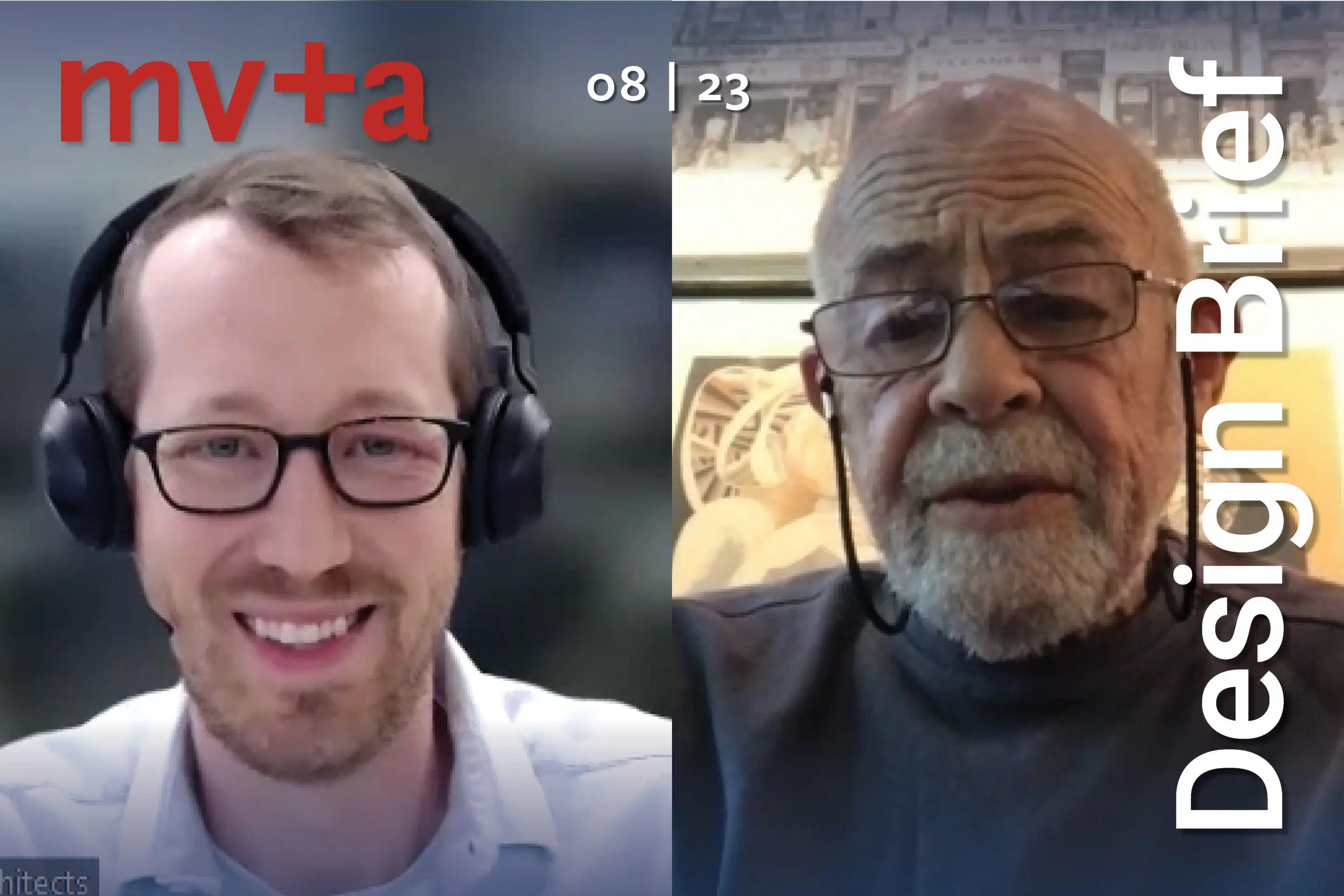
IN CONVERSATION | Allen Mushinsky
Recently, MV+A Principal Brian Szymanski sat with firm founder and Principal Emeritus Allen Mushinsky to talk about firm history + culture, innovating grocery retail design, and putting people first.
The two spoke for over 30-minutes, so the following text has been considerably edited. To watch the full discussion check out our You Tube channel.
Getting Started
BS: So, Allen, I was lucky to work with you for about two years before you retired. Although there’s been some changes over the years, I think our culture still stands true to the firm that you founded more than 40-years ago. Maybe you could start by giving us a bit of back ground on your education and your early professional years.
AM: Well, I started out in engineering for about a semester because that was the advice I got in high school, bad advice, and I realized that I really wanted to be an architect. So, I ended upgoing to Oklahoma State because I could afford it and it had a decent rating. When I graduated and came back to Washington, I wanted to do my master’s degree in urban planning. I got a job with a DC firm, and I did my master’s at Catholic University—at night and on weekends. And, after 9-years, I made partner. I had started out doing master planning, but I ended up doing large mixed-use projects. After some time, I decided to leave because I didn’t like the way firms were being run a certain way back then—relative to the staff. So, I struck out on my own without a single job prospect.
BS: When you started out, what were your professional objectives?
AM: I knew I wanted to do something different. Retail was out there and doing shopping center renovations allowed me to connect with developers. That ultimately grew into a connection with Giant Food. We did a renovation for them and then they hired us to design an entirely new center. And that was the beginning of people starting to say: “Well, you sure know how to do shopping centers.”
BS: Right. And how would you describe the state of grocery store design and retail shopping centers at the time?
AM: The market was mostly strip-centers back then. The malls didn’t have grocery stores, which I would say was a mistake, as that was where the population was. But the retail centers started to grow, and it became evident that they needed to be grocery-anchored. The problem back then was the way that grocery stores viewed themselves. The senior vice president of Giant once told me: “We need to look like a brown paper bag because we don’t have a high enough profit margin.” In time, retail started to become very profitable, and a lot of young new developers were getting into it.
What we learned at that time was that we needed to educate our clients, to teach them about how good architecture could help sell projects and attract people. And so, we started teaching them about the planning and design of the centers, about what amenities should be considered—as far as open space and so forth. And it caught on; as competition between chains intensified, they all had to look better—more upscale.
And it wasn’t just the business side that was becoming aware of this. Neighborhoods were also getting tough with the approvals process. So, we started getting hired just to get projects approved by the local neighborhoods. And we were good at it. Eventually our clients learned that they just couldn’t use their old models—the brown paper bag. They had to really improve what they were doing.
 Giant Food | Germantown, MD
Reimagining Grocery: Giant Food + Whole Foods Market
BS: Was there one project, early on, that really catapulted your work?
AM: I would say the first shopping center that we did for Giant in Germantown, really helped us enormously. The head of architecture at Giant was very supportive of us. That project really started things moving, leading to all sorts of other projects. The head of Safeway eventually contacted us to redo a store where the community was putting up a real fight. After we got it approved, they hired us to do a whole new center.
BS: This seems like a good lead into working in denser developments and mixed-use, why don’t you talk a little bit about Tivoli.
AM: Tivoli took a long time because it was a real battle with the community. It was not just the renovation of a historic theater, but it was the redevelopment of the entire city block. Also, it was a competition between development teams, and one of the prospective developers contacted us because he had been meeting with Giant—to anchor his proposed project. In their meeting, Giant’s head of architecture, Roger Pompei, told him: “You really need to get a hold of Mushinsky! He understands us.” So, it really worked out well. Ultimately, it was really a great education on historic preservation, and in working with really good teams; it was a major team effort.
Of course, that project had parking above the store, which was not commonplace at the time. Giant had wanted to have parking and pickup in front of the store. You know, drive off the sidewalk. The neighborhood was never going to let that happen. So, it took a bit to convince the people at Giant that we could make the parking work up in a garage—above the store. Now, you do it all the time because that’s just part of mixed-use.
 Tivoli Theatre | Washington, DC
 Giant Food | Tivoli Square | Washington, DC
BS: Can you speak a little bit about your introduction to Whole Foods Market and how you started doing work with them?
AM: At the end of the 80s, the economy started to tank. I had some heart problems at the time, and the firm had really reduced in size—but it was a pretty comfortable size, and I was really enjoying it while I was recuperating. I got a phone call from a consultant who was working with Whole Foods. Now, I’d never heard of Whole Foods—then Bread and Circus. They were up in Boston, and they were expanding into the DC area. And so, I said: “Look, I appreciate you calling me, but let me connect you with some other architects who do really good work with grocery stores.”
For about six months, he kept calling me, picking my brain, and asking me questions. Finally, he said: “I don’t understand why you don’t want to work for us.” And I said: “It’s not that, I’m just really happy with what we’re doing.” And he says: “Well, you really need to rethink this.” So, I went home, talked to my wife, and she said: “Just give him a number he can’t live with.” The very next day I called him and gave him a number that I thought he couldn’t live with. And he said: “That’s fine.” So, I added: “One more thing. I need to find somebody—a young architect that I think is partnership material; someone that can help grow the firm. I’m going to need a couple of months to advertise and find somebody.” And he said “Okay, fine. We’re not in a rush.” and that’s when I met and hired Jim [Voelzke]!
BS: Was the Clarendon Whole Foods Market, or rather, Bread and Circus, the first?
AM: It was. What’s amazing about that project is that the site was so tight. It took a lot of rezoning and finessing as we needed part of the street to complete the project. That was a really big deal—and we got it! It turned out to be an exceptional building architecturally, as well as from a planning standpoint, and it was right for the neighborhood. After the founder of Whole Foods came for the grand opening, he sent out an email to all the regional presidents asking: “Why don’t ALL our buildings look like this?” Well, they had never actually done a new building; they had always moved into old grocery stores and renovated the interiors. Up to then, they really didn’t have anybody working creatively with them.
BS: That building really pushed the boundaries of what the form of a grocery store could be like—it doesn’t just need to be a square box. How can you treat blank facades to make them fit into an urban context? How can you create a human scale for the building? It can have a form to the roof. It can have beautiful brick material detailing. I mean, it’s wonderful.
AM: It was about people and shopping, and the community, of course. There was a lot to be learned. And there was an education that happened for us as well as with us teaching them what their stores could be like.
 Bread & Circus, now Whole Foods Market | Clarendon | Arlington, VA
 Whole Foods Market | P Street | Washington, DC
BS: How did you balance what you were good at versus expanding into new sectors and areas of expertise?
AM: We never tried to break into the office market, there were already a lot of DC commercial architecture firms—with all the office buildings being built in the region. That market was really tied up, so, what we tried to do was to build on the retail end of all that, which meant: shopping centers. I definitely wanted to move it into a more urban, mixed-use context. I knew a lot of the developers building high-rises would want Whole Foods Market for their anchors. And when many of them started to work with Whole Foods, they [Whole Foods] would say: “Talk to MV+A and see if they think this or that will work.” Over time we went from designing anchor stores to designing entire mixed-use building projects with Whole Foods Market anchors.
 Whole Foods Market Projects [Clockwise from Top Left]: Clevland, OH | Wynnewood, PA | Tysons, VA | Towson, MD
 Liberty East Whole Foods Market | Pittsburg, PA
“It’s All About Relationships.”
BS: So, it’s clear that our grocery work has helped us expand from shopping centers to mixed-use buildings with grocery anchors. You mentioned not getting into the commercial office market, but now we’re doing office buildings with grocery anchors. We’re also doing more projects that are purely residential buildings because of all our mixed-use, multifamily work. We’re even doing master planning projects that aren’t grocery anchored, like our Virginia Village project.
AM: I’ll never forget when we got the project at Riverdale, with Whole Foods as an anchor, and a fairly robust retail component. I was always worried that they were going to go with somebody else to do the residential. But, after building a good relationship with the client, they had you [MV+A] do the residential. It’s all about relationships.
BS: That’s right, we’ve done every building on the site thus far. That project is such a great example of the breadth and depth of our expertise—from large scale master planning and entitling such a massive project, to designing and constructing all of those buildings, as well as designing the interiors of the Whole Foods Market. It really has been such a great project for us.
AM: And that gets you to the staff—once you get the project, you have to have the right staff. From the planning down to the detailing of the building, if you don’t have it, one of those things is going to trip you up with the client.
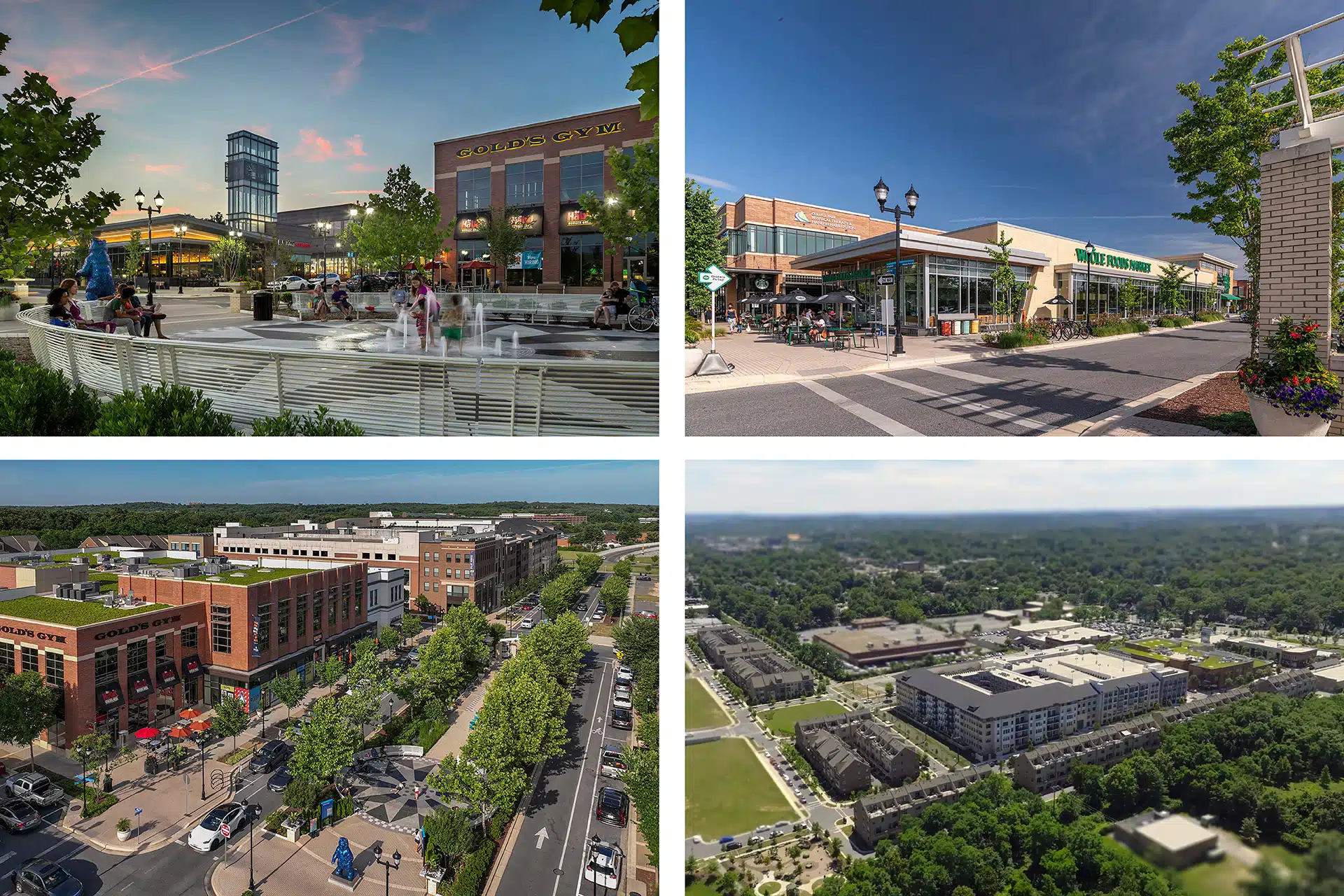 Riverdale Park Station | Riverdale Park, MD
BS: I think the size of our firm has allowed our staff to get exposure to so many different portions of the work. That allows us to be nimble; now that multifamily may be slowing, commercial renovation work is picking up and we’re able to pivot skillfully, which is critical.
AM: And that’s exactly how you manage a firm. You don’t give up something that you did to get you started because you got into something better, or bigger. You maintain that expertise, it’s part of your reputation.
BS: Right. We want to be known as masters of retail—big and small. Since the beginning, we’ve been doing retail big and small. We’re still just as happy to do just a small pad retail building as we are to do a big mixed use residential project or master plan. They’re all nice to do.
AM: They’re ALL architecture and what you should be bringing to each of those projects is a certain amount of creativity and understanding of what you’re trying to accomplish. And there are going to be different levels of economy with the projects that you do. So, you have to just roll with it and do your best job.
BS: That goes to my next thought. Over your years of practice, how have you seen the world of retail change or is it more of the same just with a different aesthetic?
AM: I think there’s certainly a better aesthetic. There’s a recognition by all the players that you need to attract people and that good design attracts more people. People appreciate good design. They may not be sure why, but they like going there. And so, developers have learned that this is really important and they’re willing to pay more for that. The thing is not to start feeling comfortable and just using the same design aesthetic over and over again.
 Retail Projects [Clockwise from Top Left]: Kentlands Market Square, Gaithersburg, MD | Cabin John Village, Potomac, MD | Gateway University Town Center, Hyattsville, MD | Broaddale Village, Falls Church, VA
BS: What would you say are the things you miss most about the profession?
AM: I think the most important thing is just working with the teams—with the staff. I learn something every time I work with people and, hopefully, they learn something too. To me that was the most fun. I’ve always thought that was what architecture was about. Architecture is not one person doing a design. It is always about collaboration. And so, I DO miss that.
BS: Is there anything else you’d like to add in closing? Some advice or words of wisdom for us here at MV+A?
AM: I think what you’re doing, and the kind of growth you’ve had is in line with what I had hoped to accomplish. Before I retired, what I really hoped for was for the firm to be able to move on and do well. The firm has grown beyond what it was when I left. It’s grown in a very good way, not just because of the projects, but because of how the firm is working. You have a diverse group of people and that’s extremely important. And it seems like Jim is very open about how the whole firm is run. That’s very important. As I mentioned, I left another firm because that wasn’t happening. I was a partner and didn’t know everything that was going on, and I don’t think things should be done that way. The other thing I think is very important is how you treat your consultants. They are really an important part of the equation. In hard times, they were always there to help us. If you take care of your consultants, they will take care of you. That’s really important for a firm to appreciate.
BS: Well Allen, it was really great chatting with you and revisiting some of the history of the firm. While it’s been some time since your retirement, I really do feel like our values still hold true to what you started many years ago and I really appreciate you taking the time to talk with me today.
AM: Thank you Brian—it’s been wonderful, and I look forward to coming down and seeing the new office as well!